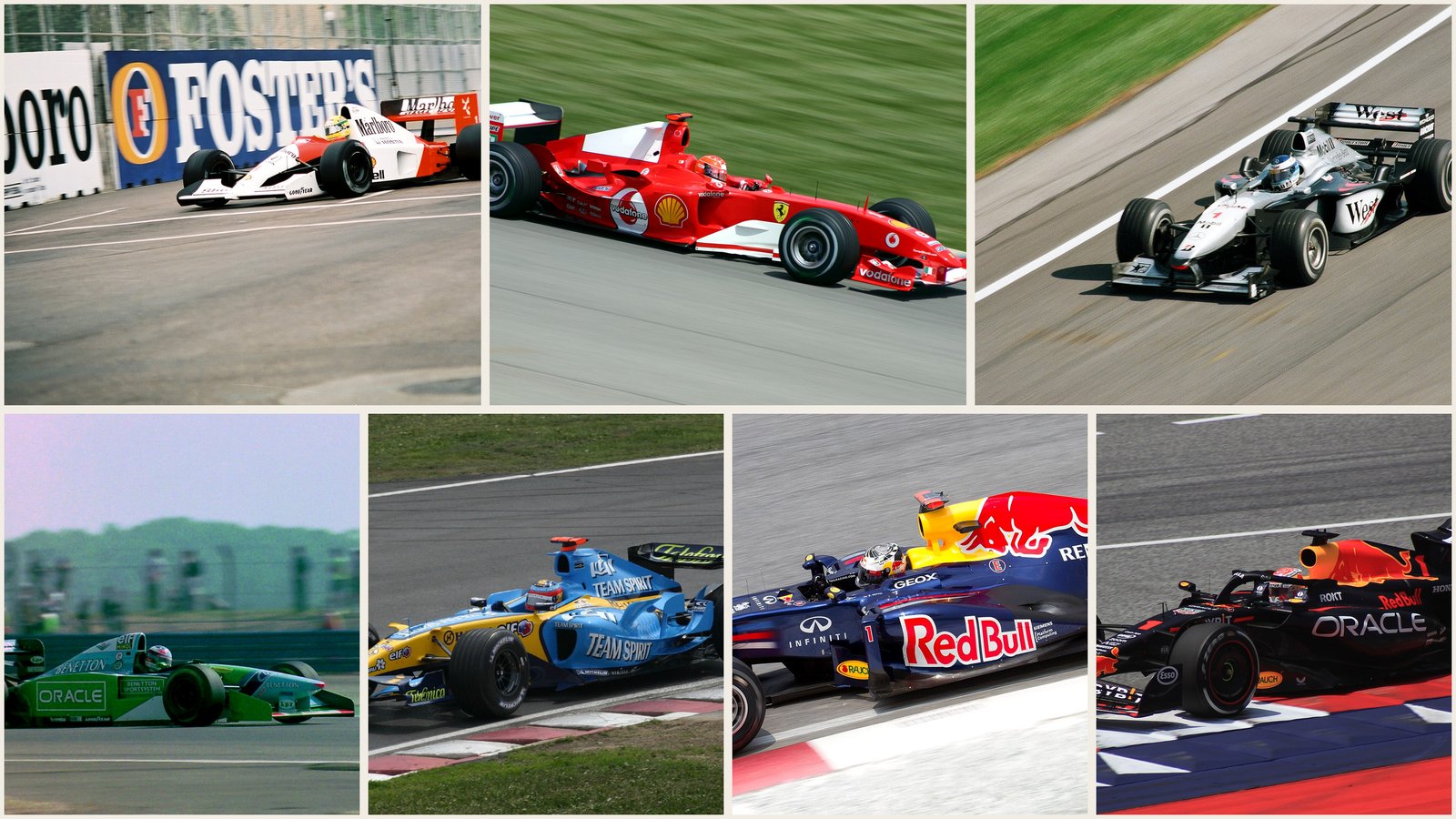
Five red lights. Twenty-two cars hold their breath. The lights vanish and several hundred million dollars charge toward a corner built for considerably fewer opinions. One driver launches perfectly. Another sees a gap. Somebody detects rain. Before lap one is complete, years of preparation have become a live test of judgment, teamwork and nerve.
Formula One is genius, weather, courage and several thousand brilliant people discovering—usually on live television—that Sunday has invented an even better story.
Formula One history, in one breath: Fangio hunted two Ferraris around the Nürburgring; Schumacher swept around Alesi for victory at the Nürburgring; Vettel made little Toro Rosso mighty in rain-soaked Monza; Alonso made his Renault as wide as Imola to keep Schumacher behind; Senna passed four cars on Donington’s first wet lap; Häkkinen split Schumacher and a backmarker at 321 kilometres per hour; Button made six pit visits and still won Canada; Hamilton found a championship in Brazil’s final corners; Verstappen started seventeenth in São Paulo rain and arrived first. This is not a procession of regulations. It is preparation transformed by weather, nerve and imagination.
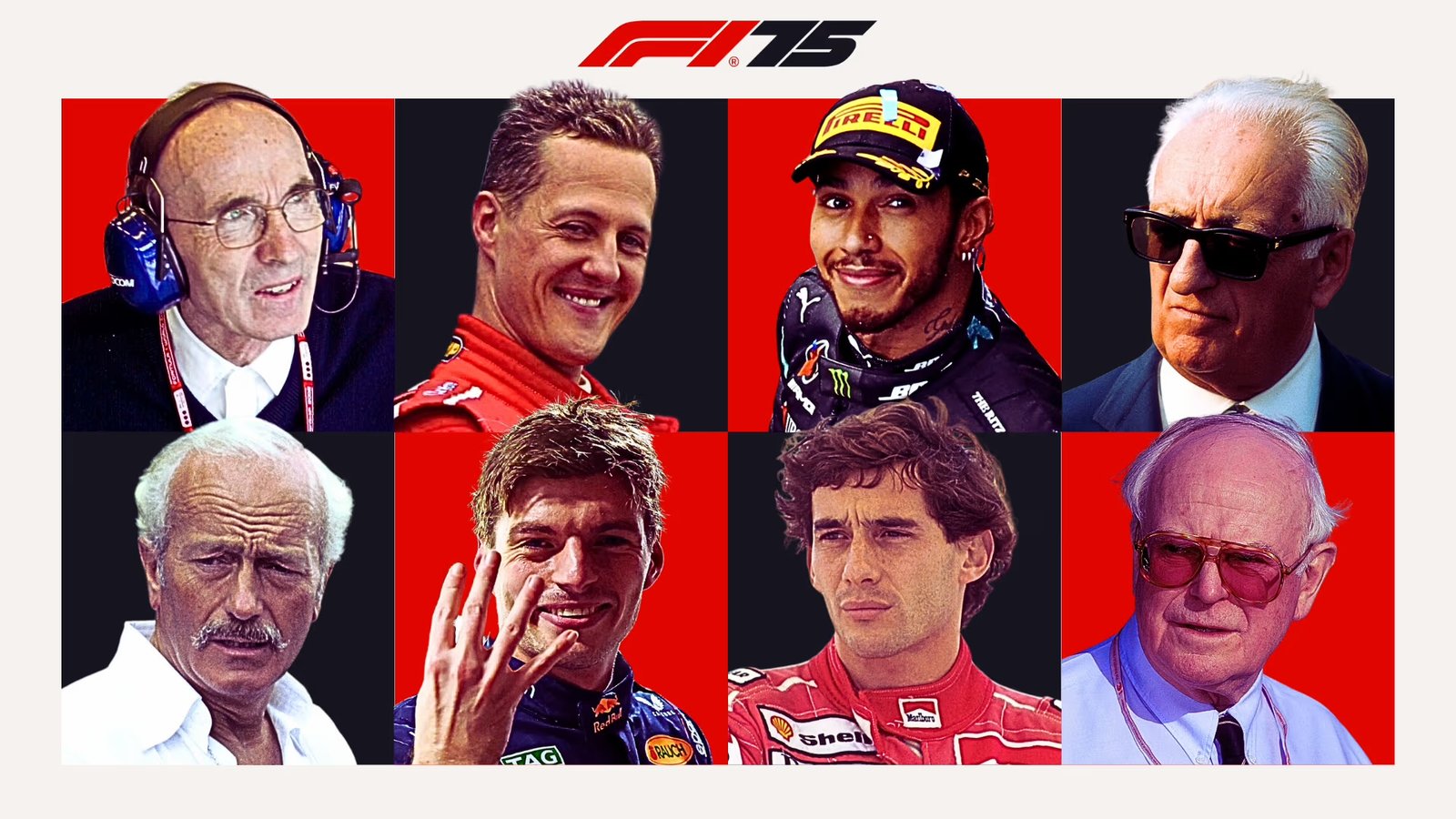
F1 at 75: builders, champions and personalities who turned engineering into folklore.
Image supplied by the author.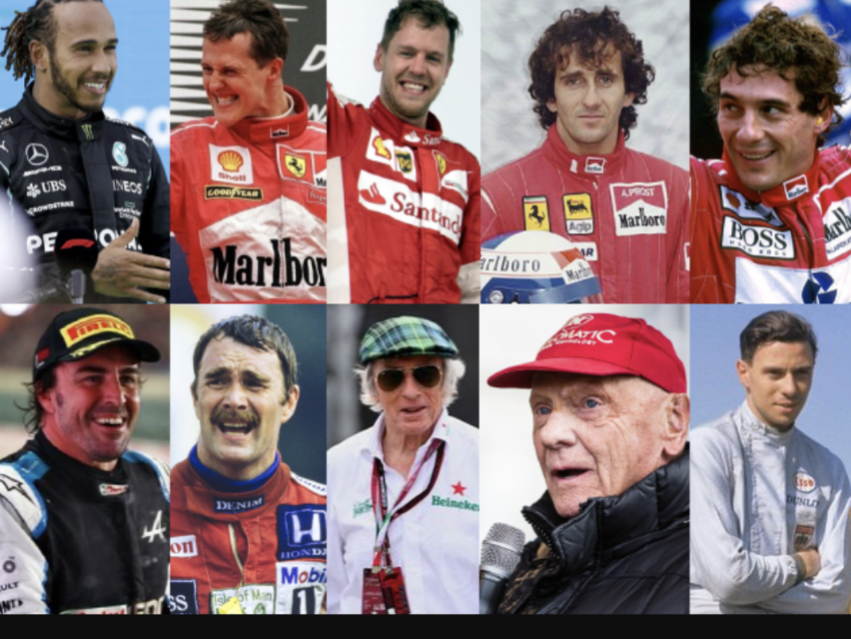
Ten familiar faces, ten completely different answers to the same stopwatch.
Image supplied by the author.At the fence, speed becomes physical: pressure in the chest, a downshift in the bones, heat shimmer swallowing a car that changes direction as if mass were gossip. Television explains the undercut. The fence explains why reasonable adults cross oceans to hear one.
Behind that sensation sit eleven design cultures, founders, manufacturers and ambitious owners; mechanics building precision by hand; engineers sculpting air nobody can see; and drivers choosing among thousands of simulated futures because one patch of asphalt feels different through the seat. It is laboratory, opera, traveling circus and the world’s fastest group project.
Formula One honors its lost heroes by turning remembrance into action: stronger cars, safer circuits, better medical response and a duty never to confuse tragedy with entertainment. Its purest idea endures: ambition meets stopwatch; machine meets weather; human judgment gets the final corner. This article is the history, the engineering and the mischief—but above all, a love letter to humanity’s refusal to stop improving.
I · The central idea
A stopwatch with a soul
The formula is the rulebook; the fun is every ingenious answer it invites. Each constructor builds its own chassis and integrates power, cooling, suspension and aerodynamics. Formula One therefore asks a magnificently untidy question: what is the fastest organization humans can assemble?
The driver brings nerve, feel and feedback. The constructor brings the instrument and several hundred people who measure everything twice. Clark needed Chapman’s Lotus; Schumacher needed Todt, Brawn, Byrne and Ferrari; Hamilton met Mercedes at full hybrid brilliance; Verstappen found a Red Bull sharp enough to speak his dialect. Sunday is one race. The factory is the quieter race underneath it.
A Formula One car is always a work in progress. On the grid, it is the team’s fastest answer so far—and somewhere in the paddock, someone is already dreaming up a quicker one.
That is the heartbeat of Formula One: a front wing can take months to design, a floor thousands of simulated runs and a race plan days of tire modeling. Then the lights go out and the team may have half a lap to decide whether a shower is real, two seconds to call the car into pit lane and one heartbeat for the driver to choose inside or outside.
Formula One measures laps to the thousandth, but precision is not cold; it is collective courage with a stopwatch attached. Driver, engineer, strategist, mechanic, simulator crew and factory all place their work inside the same disappearing moment. A career can turn on one qualifying lap, a team’s future on one rules cycle and a manufacturer’s reputation on whether years of research work at Turn One. Preparation creates the possibilities. Human judgment chooses among them.
II · Why the grandstands keep filling
The expensive ticket that becomes a physical memory
Television shows the racing line. A grandstand makes it shake your ribs. You hear the downshifts ricochet between buildings, feel the air move when the field passes and discover that twenty cars arriving together are less a sound than a weather event. The screen is better for data; the fence is better for belief.
That is why fans accept expensive tickets, crowded trains, sunburn, rain and a suspiciously ambitious sandwich. They come for speed and stay for the layers: the hometown driver, the Ferrari red, the papaya or orange tribe, the pit-stop gamble, the dark cloud approaching Turn Seven and the midfield car stubbornly refusing to behave according to its budget.
A Grand Prix is a two-hour story whose author can change at every corner—and the crowd gets to feel the punctuation.
The 2025 Global Fan Survey found speed and performance remained the strongest motivators, with nine in ten respondents emotionally invested in race outcomes. Live attendance then reached 6.7 million across the 2025 season. The attraction is not simply noise or celebrity. It is participation: fans read tire choices, watch pit crews assemble and dissolve, argue over gaps and sense an overtake growing three laps before it happens. A race ticket buys no guarantee of drama. It buys a front-row seat to possibility.
III · The part no algorithm can replace
Drivers: skill, myth, personality—and the people fans choose
A Formula One driver is not luggage in an intelligent car. There is no stability control, anti-lock rescue or button marked please find grip. The driver brakes with enormous force, eases pressure as downforce falls, rotates the car and feels a slide before television notices it. Qualifying asks for one perfect sentence; racing asks for fifty-seven accurate paragraphs.
Tires are shoes with moods: too cold, no grip; too hot, also no grip, only more expensive. Drivers adjust line, balance and pace while heat loads the body and the steering wheel resembles a small appliance store. Engineers advise; at 300 kilometres per hour, the cockpit remains the final processor.
Eight Sundays that turned skill into aura
Aura is not smoke, lighting and a good helmet—although Senna’s yellow lid helped. It is repeatable technique compressed into one image a grandstand never forgets: the champion improvising with a wounded gearbox, the rain master finding grip nobody else can see, the rival daring to pass where two cars and one backmarker briefly occupy the same piece of Belgium.
Skill becoming folklore
The races that explained the driver
Each performance made an invisible skill visible. The machinery and circumstance mattered; the driver still had to recognize the opportunity before everybody else.
| Driver and race | What happened | What the performance revealed |
|---|---|---|
| Senna · Brazil 1991 | Won at home with only sixth gear | Endurance breaking through the armor |
| Schumacher · Spain 1996 | Won the deluge by 45 seconds in a difficult Ferrari | Wet-line invention; imperfect car, perfect afternoon |
| Häkkinen · Spa 2000 | Split Schumacher and Zonta at 321 km/h | Spatial imagination without theatre |
| Alonso · Imola 2005 | Made his Renault as wide as Italy | Defensive geometry and nerve |
| Vettel · Brazil 2012 | Spun, damaged the car, recovered and took the title | Composure when the metronome fell downstairs |
| Hamilton / Rosberg · Bahrain 2014 | Traded attacks and still finished one-two | Friendship becoming championship electricity |
| Verstappen · Abu Dhabi 2021 | Took the last-lap chance and his first crown | Season-long attack meeting one final opening |
| Verstappen · São Paulo 2024 | Seventeenth to first in rain | Grip-mapping at heroic speed |
Myth improves when context remains attached. Luck, machinery and officiating can change the stage; they do not drive the car across it.
Why fans choose a person before they choose a team
The driver makes an enormous technical sport human-sized. A helmet, voice, fearless pass, joke or inherited family favorite can create allegiance for life. Popularity moves like weather; what lasts is the quality supporters recognize in someone driving something impossible.
Red Bull shows drivers teaching fans what a team means. Vettel turned an irreverent drinks brand into a four-title dynasty: raised finger, qualifying laps, exhaust-blown cars and delighted radio. Verstappen defined the sequel with harder energy—late braking, tiny corrections, blunt speech and orange grandstands. Vettel made Red Bull legitimate; Verstappen made it formidable again. One was the metronome, the other the dare. Together they built twenty years of mythology without borrowing a century-old road-car badge.
The great archetypes: what made them loved, resisted and unforgettable
Fangio was the adaptor; Clark the natural; Graham Hill the witty Monaco host. Damon Hill carried quiet resilience, Mansell a heroic brass band and Stewart the elegant conviction that courage should come home alive.
Lauda and Hunt made contrast irresistible; Prost and Senna made philosophy race itself. Schumacher expanded the job into fitness, testing and institution-building, while Häkkinen answered with privacy, dry humor and devastating speed.
Alonso turns fifth into a campaign; Räikkönen became famous by declining to narrate himself; Vettel traveled from raised-finger dominance to warm, historically curious elder. Time often returns the dimensions that winning temporarily hides.
Hamilton and Verstappen: two shadows large enough to change the landscape
Hamilton grew from rookie sensation into a master of late braking, rain, tires and longevity. Mercedes gave him a dynasty; he gave Mercedes reach beyond the paddock and proved that champions need not be visually interchangeable.
Verstappen commits early, accepts movement and corrects slides almost before viewers receive them. Sim racing is natural; his wheel-to-wheel instinct gloriously old-fashioned. He is also an excellent tire manager, inconveniently ruining the cartoon of permanent attack. Orange grandstands turned the result into a traveling Dutch festival.
With engineer Gianpiero Lambiase, Verstappen sounds like one half of a live sitcom built on trust. Hamilton and Verstappen became symbols for teams and generations, but neither became great because the other lost. Popularity is an unreliable lap time; judge the move, enjoy the competition and let historical respect arrive in its own time.
The grid’s chaos merchants—and the careers that refused to be tidy
There are no slow Formula One drivers—only fast people compared with nineteen statistical abnormalities. De Cesaris was very fast and rarely tidy; Maldonado became incident shorthand, then drove a perfect 2012 Spanish Grand Prix; Grosjean learned from a race ban and collected ten podiums. One immaculate Sunday can heckle a reputation forever.
IV · When the plan learns to improvise
Chaos, radio and the glorious Sundays nobody could script
Every team arrives with weather models, tire curves and thousands of simulated Sundays. Then one cloud parks above Turn Seven, a wheel nut develops principles and two teammates remember Malaysia. Precision is dramatic because a safety car can erase it. Racing becomes entertainment at the exact point certainty runs out.
The funniest thing about Formula One is how often the world’s most prepared sport looks completely surprised by Formula One.
Rain: the great equalizer—and the great liar
Rain rewrites the information system: paint turns greasy, spray steals braking points and grip maps expire every few seconds. Senna attacked, Hamilton found calm, Verstappen invented lines and Button simply refused to stop trying. Wet-weather mastery is learning fastest while leaving room for the puddle nobody has met.
The radio is live, unfortunately
Team radio is the world’s fastest workplace conversation: a driver at the limit, an engineer compressing weather into six words and millions listening. One selected sentence is not a personality test; it is the moment the media trainer arrived one second late.
Hot microphone, hot cockpit
Eight radio messages that became part of the story
The best lines work because the context is already racing at 300 kilometres per hour. They are jokes, rebellions and stress fractures—not always fair summaries of the people speaking.
| Moment | The line | What the fans heard inside it |
|---|---|---|
| Mark Webber · Silverstone 2010 | ‘Not bad for a number two driver.’ | Victory served with dry revenge |
| Kimi Räikkönen · Abu Dhabi 2012 | ‘Just leave me alone, I know what to do!’ | Irritation, independence—and he did win |
| Sebastian Vettel · Malaysia 2013 | ‘Multi 21, Seb.’ | Team order meets a driver choosing victory |
| Fernando Alonso · Suzuka 2015 | ‘GP2 engine.’ | Competitive frustration in four public syllables |
| Sebastian Vettel · Brazil 2018 | Something is loose—apart from the obvious front wing | Deadpan understatement in a rearranging car |
| Daniel Ricciardo · Monza 2021 | He never left; he stepped aside | A joke carrying years of relief |
| Max Verstappen · victory radio | ‘Simply lovely.’ | Two words becoming an era’s soundtrack |
| Lewis Hamilton · Miami 2025 | ‘Have a tea break while you’re at it.’ | Sarcasm while Ferrari considered a swap |
Radio is delayed and editorially selected. Hear the emotion, enjoy the line, then remember that a career is longer than one transmission.
Kimi made irritation funny; Webber made hierarchy a punchline; Verstappen’s ‘Simply lovely’ became famous enough for Norris to borrow. Radio also lets the armor fall: Senna cried after Brazil 1991; Schumacher wept at Monza 2000.
When the helmets came off and emotion arrived first
Rivals compete at the limit and depend on trust from the car beside them. History includes moments when adrenaline outran judgment, but the best rivalries return emotion to the track. Pointed press conferences add spice; the payoff is the next impossible braking move and the chance to answer it.
Safety miracles—and what engineering learns
After a crash, the important questions are why the driver survived and what improves next. Carbon cells, HANS, halo, tethers, barriers, clothing and medical response let the car remain outrageous while safety keeps advancing. Real-world evidence settled the aesthetic debates.
The comebacks that rewrote the obvious ending
Lauda returning with burns healing, Häkkinen rebuilding to two titles, Kubica returning after eight years, Button’s six-stop win and Hamilton’s São Paulo charge shared one skill: remaining ready when racing offered another life. Fortune opens doors; great drivers reach them before they close.
Formula One is also wonderfully ridiculous
Räikkönen waited out Malaysian rain with an ice cream; Petrov briefly turned a Renault into an aircraft; Tyrrell tried six wheels because four lacked ambition. Drivers sing, shoey and lose arguments with drinks bottles. Formula One is best when engineering stays serious and the humans remain funny, fearless and magnificent.
V · Machines with biographies
The cars people came to see—and the constructor souls inside them
Great cars acquire faces. A shark nose, a high airbox, a low red-and-white blade, a scarlet V10 car or a dark blue ground-effect machine becomes recognizable before the number. Senna and the MP4/4, Mansell and the FW14B, Schumacher and the F2004, Hamilton and the W11, Verstappen and the RB19: the car is not scenery. It is the other lead actor.
The cars that changed the sport’s vocabulary
An engineering hall of fame
Fourteen machines that made a new kind of speed visible
The list favors cars that joined performance to a memorable idea. Some dominated; others mattered because the grid had to think differently after seeing them.
| Car | The decisive idea | Why it remains special |
|---|---|---|
| Alfa 158/159 | Supercharged pre-war brilliance | The championship’s first thunderous benchmark |
| Cooper T51/T53 | Rear engine | Brabham made the old layout obsolete |
| Lotus 25 | Light monocoque | Clark and Chapman became one pencil line |
| Lotus 49 | Structural Cosworth DFV | A shared key for independent teams |
| Ferrari 312T | Flat-12, transverse gearbox | Forghieri and Lauda restored red order |
| Lotus 79 | Ground-effect tunnels | The black beauty made suction glamorous |
| McLaren MP4/1 | Carbon monocoque | Lightness and survival joined forces |
| McLaren MP4/4 | Tight Honda integration | Fifteen wins; almost impolite coherence |
| Williams FW14B | Active suspension | Serenity beneath Mansell’s attack |
| Ferrari F2004 | Every department fast | Schumacher’s system in scarlet form |
| Renault R25 | Traction and platform control | Alonso ended the red empire in blue and yellow |
| Brawn BGP 001 | Double diffuser | A rescued team won its only season |
| Mercedes W11 | Hybrid maturity and DAS | Devastating speed, calmly repeated |
| Red Bull RB19 | Ground-effect efficiency | Twenty-one wins and one blue blur |
Engineering greatness is not only a win percentage. The Cooper, Lotus 25 and MP4/1 changed the default architecture; their influence continued after their own trophies were counted.
Why Ferrari occupies a place no other team can copy
Ferrari’s place comes from continuity and contradiction. It has raced in every championship season, carries Italy’s red and still connects Maranello road-car fantasy to Enzo Ferrari’s original purpose. Most manufacturers race to excite the company. Ferrari built the company to keep racing.
The tifosi treat results as inheritance: victory is public joy, strategic confusion a family discussion conducted at stadium volume. The family album runs from Ascari’s 500 and the Sharknose to Lauda’s 312T, Villeneuve’s difficult beauties and Schumacher’s F2004. Ferrari asks every champion to enter a story older than themselves—Lauda brought severity, Villeneuve romance, Schumacher reconstruction, Alonso urgency, Leclerc hope. Fans watch what the driver does to Ferrari, and what Ferrari does to the driver.
Every great constructor develops a recognizable soul
- Lotus — the idea laboratory. Its best cars looked like the future arriving without permission.
- McLaren — Bruce’s warm pragmatism, Dennis’s immaculate precision and modern papaya renewal. Senna, Häkkinen and Hamilton each found a different McLaren.
- Williams — independence made heroic. Frank Williams and Patrick Head built cars capable of staring down factories without pretending to be one.
- Benetton / Renault — fashion color became Schumacher substance; blue-and-yellow Renault later gave Alonso the keys to Ferrari’s gate.
- Mercedes — industrial depth, silver discipline and the W11: excellence repeated until repetition itself became extraordinary.
- Red Bull — loud hospitality matured into Newey aerodynamics, Vettel’s metronome and Verstappen’s dare. A consumer brand became racing royalty.
- Brabham, Tyrrell, Jordan, Minardi, Sauber and Brawn — the clever rooms where fans learned that improbable cars are often the ones worth loving.
When the grid dressed louder than the engines
Cars once arrived like a moving record collection: Lotus in black and gold, McLaren in red and white, Jordan with snakes and hornets, Renault in blue and yellow, and Benetton apparently painted by a fashion house during a very successful party. A livery did more than identify a sponsor. It gave a shape an attitude, and fans could recognize the car from the far side of Eau Rouge before the timing screen bothered to help.
Modern cars are safer, faster and far more intricately surfaced, but optimization can make silhouettes converge and exposed carbon can turn saved paint into another shade of black. The grid has not lost color—Ferrari red, McLaren papaya and Red Bull blue still carry whole tribes—but it could use more visual mischief. Paint cannot add downforce. It can make a child choose a favorite for life, which may be the more impressive technology.
The people who make teams feel like nations
Founders, conductors and the man with the notebook
A Formula One team inherits the personality of whoever decides what excellence should feel like. Enzo Ferrari made racing an Italian epic; Frank Williams made persistence an operating system; Ron Dennis industrialized precision; Adrian Newey repeatedly found performance in the air itself.

Enzo Ferrari
The constructor as patriarch, provocateur and keeper of a national myth.
Rainer W. Schlegelmilch · public domain in Italy
Sir Frank Williams
An independent racer whose refusal to disappear became one of the sport’s great institutions.
LyndseyWF1 / Williams F1 · CC0
Ron Dennis
Project Four discipline turned McLaren into a technical, sporting and design culture.
Stuart Seeger · CC BY 2.0
Adrian Newey
The rare designer whose work helped define winning eras at Williams, McLaren and Red Bull—and now a team principal at Aston Martin.
Morio · CC BY-SA 3.0A great pairing makes driver and car seem inevitable: Clark–Lotus, Lauda–312T, Senna–MP4/4, Mansell–FW14B, Schumacher–F2004, Hamilton–W11, Verstappen–RB19. These are not biographies parked together. They are Formula One’s compound nouns.
VI · The officials inside the storm
Race control and the fastest courtroom in sport
While the cars improvise, another team watches every marshal post, camera, timing loop and patch of weather. The circuit organizer and clerk of the course run the venue’s local operation; marshals become its eyes and hands. The FIA race director controls the session—starts, stoppages, Safety Cars and the safe conduct of the event. Independent stewards examine alleged breaches and decide penalties. One group manages the race. The other judges the incidents it produces.
That distinction disappears quickly when the result changes. Vettel’s five-second penalty in Canada 2019 handed victory to Hamilton and launched a thousand imaginary law degrees. The final-lap procedure in Abu Dhabi 2021 altered the championship’s ending and led to an FIA review, revised structures and a new race director. Track-limits and overtaking decisions continue to divide grandstands because fluid movement must be translated into fixed words while the championship clock is still running.
At 300 kilometres per hour, every driver is an artist in the cockpit and—over the radio—a remarkably available barrister.
Drivers and teams report rivals because radio is also evidence, persuasion and competitive reflex: unsafe release, track limits, gaining an advantage, debris, rain. The lobbying is part of the theater, but it is not proof that a favored driver or team exists. Fans see decisions through allegiance; stewards must publish reasons, compare precedent and accept scrutiny. Consistency matters because uncertainty should come from the race, not from guessing how the rulebook will wake up that morning.
Perfect objectivity is difficult when no two overtakes arrive with identical speed, overlap, grip or runoff. The constructive answer is clearer guidance, public decisions, better technology and honest review—not removing human judgment from a human contest. Officials should protect the stage without becoming the main act. When they do the job beautifully, nobody buys their cap on the way home.
VII · The prehistory
Before the World Championship, there was the road
Motor racing began almost as soon as two motorists met and asked the most irresistible question in motion: who is faster? The city-to-city contests of the 1890s became sport, industrial demonstration and shared adventure. By 1906 the French Grand Prix had a name, manufacturers had national colors and speed had become advertising with goggles.
The 1930s brought Nuvolari, Caracciola, Rosemeyer and the supercharged Silver Arrows—immense power on roads with very little forgiveness. War stopped the noise. Racing returned, and the FIA assembled a World Championship. At Silverstone on May 13, 1950, Giuseppe Farina won for Alfa Romeo on an old airfield. A global epic began in a place still carrying runway markings.
Before 1950 · Speed in a woollen helmet
The ancestors arrive with goggles, courage and almost no spare road
The World Championship inherited its romance from drivers who had already made continental racing feel mythic.

Tazio Nuvolari · Alfa Romeo 6C
Photo & licence
Rudolf Caracciola · Mercedes-Benz W25
Photo & licence
Bernd Rosemeyer · Auto Union Type C
Photo & licence
Giuseppe Farina · Alfa Romeo 159
Photo & licenceVIII · 1950–1958
Front-engined thunder and the authority of Fangio
The first championship cars put the engine ahead of the driver and a bonnet ahead of almost everything else. Alfa’s supercharged Alfettas howled; Ferrari and Maserati replied; Mercedes returned with the W196 and the unsettling calm of people who had measured everything twice.
Fangio made the age look almost courteous. He won five titles with four marques because he could adapt, preserve a fragile machine and distinguish brave from merely expensive. Ascari gave Ferrari icy precision; Moss became the beloved champion without a crown. They wrestled steering, rationed drum brakes and diagnosed trouble by sound. The dashboard knew less, so the driver had to know more.
The badges already had character. Mercedes was order. Maserati was brilliance on a nervous bank balance. Enzo Ferrari understood that a red car and a dramatic driver could become Italian folklore. Formula One discovered its oldest business lesson early: winning Sunday and surviving Monday are different skills.
1950–1958 · Bonnet, brakes and bravery
The first champions sat behind the engine and ahead of certainty
These cars moved, drank fuel and asked the driver to serve as mechanic, weather station and survival computer.

Juan Manuel Fangio · Mercedes W196
Adaptable enough to win anywhere.
Photo & licence
Alberto Ascari · Ferrari 500
Photo & licence
Stirling Moss · Maserati 250F
Photo & licence
Mike Hawthorn · Ferrari Dino 246
Photo & licence
Peter Collins · Ferrari 801
Photo & licenceIX · 1959–1967
The garagistes turn the car around
Cooper put the engine behind the driver, where traditionalists considered it impolite, and Jack Brabham won the 1959 and 1960 titles. Ferrari moved rearward once the stopwatch settled the debate. Then Brabham founded his own team and won the 1966 championship in a car wearing his own name—the ultimate answer to ‘fine, I’ll do it myself.’
Colin Chapman made Lotus the grid’s idea factory. The monocoque Lotus 25 wrapped tightly around Jim Clark, whose vast understanding produced almost no visible fuss. Clark and car looked like a single pencil line moving through a corner.
Graham Hill supplied eyebrows, wit and five Monaco wins. He could make speed feel like a dinner party and still leave first. The Lotus 49 then used the Cosworth DFV engine as part of the structure; the compact V8 eventually powered twelve Drivers’ titles and gave small constructors access to serious speed.
Ferrari called the British specialists garagistes. Cooper, Lotus, Brabham, McLaren, Tyrrell and Williams embraced the label and kept collecting trophies. They proved that a clever room, a customer engine and the confidence to challenge convention could compete with an empire.
1959–1969 · The engine moves behind
Five British-school originals make lightness look like mischief
Cooper, Lotus, Brabham, McLaren and Matra changed the silhouette—and the driver suddenly sat at the sharp end of a much smaller idea.

Jack Brabham · Brabham BT19
Built the answer, then drove it.
Photo & licence
Jim Clark · Lotus 25
A pencil line with a heartbeat.
Photo & licence
Graham Hill · Lotus 49B
Photo & licence
Bruce McLaren · McLaren M7C
Photo & licence
Jackie Stewart · Matra MS10
Silk at the wheel, steel on safety.
Photo & licenceX · 1968–1982
Wings, sponsorship, ground effect and the discovery of invisible grip
The cars grew wings, and air became the grid’s invisible horsepower. Lotus also traded British racing green for Gold Leaf red, white and gold, turning sponsorship into a new economic engine. Early devices were bold; stronger rules made them safer. The central idea endured: persuade the air to press the tire into the road.
The drivers matched the invention. Stewart was silk at the wheel and steel on safety; Fittipaldi calm; Hunt the after-party on the front row; Lauda the engineer who happened to race. In 1976 Lauda showed two kinds of courage: returning after fire, then choosing safety in Fuji’s rain.
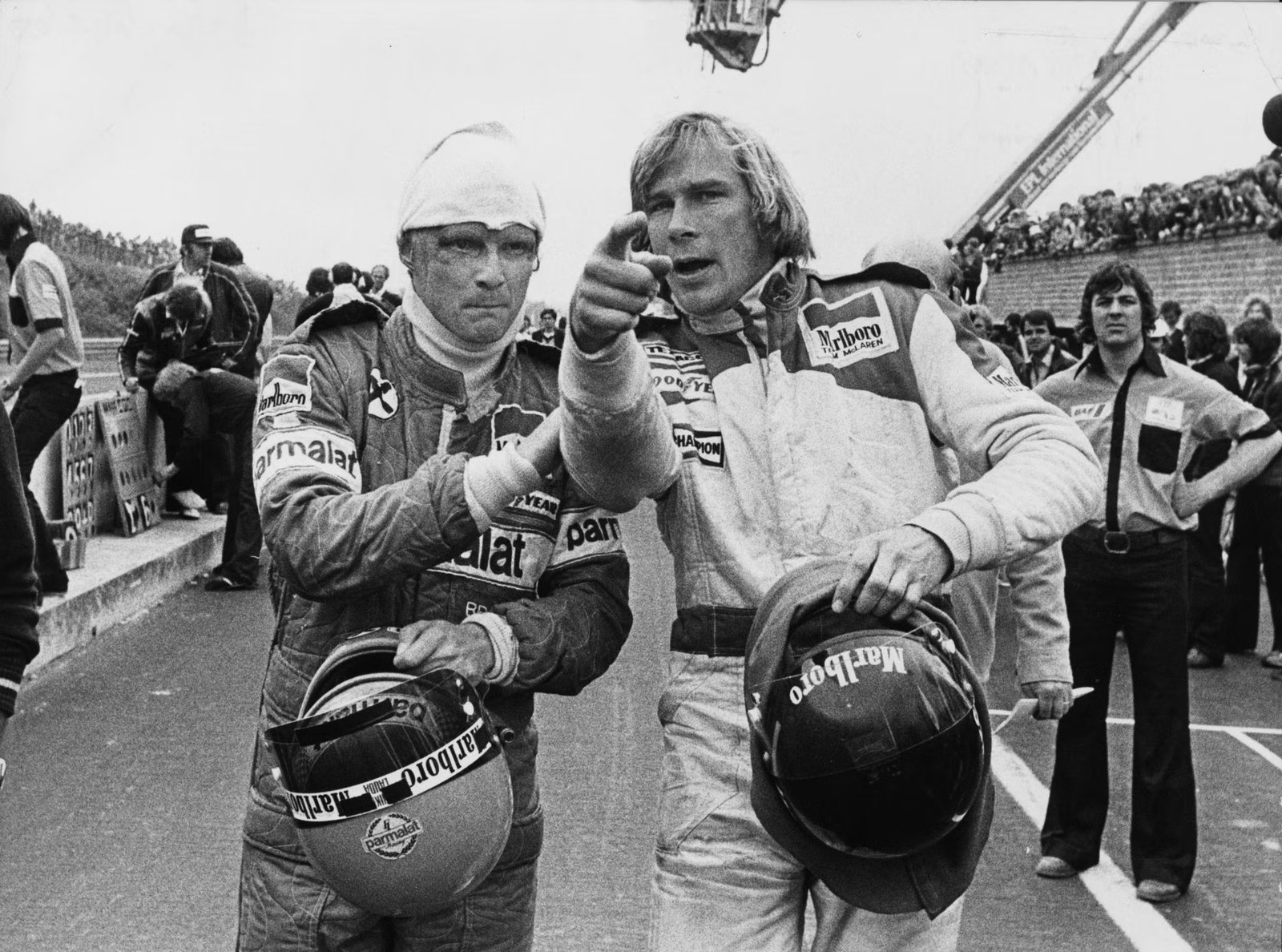
Lauda and Hunt: the contrast was irresistible, the competition was fierce and the respect survived it.
Image supplied by the author.
1975 · Lauda and the 312T
The engineer-driver finds his red instrument
Lauda did not merely drive Ferrari’s flat-12 312T quickly. His precise feedback helped the team turn promise into a repeatable championship machine. At Monza in 1975, Regazzoni won while Lauda’s third place secured the Drivers’ title in front of the tifosi.
Photo: Rainer W. Schlegelmilch / Wikimedia CommonsLotus taught the floor to become a wing; Andretti took the 1978 title and everybody copied it. Renault arrived with a smoky little turbo V6—the yellow ‘teapot’—then made the joke produce horsepower. Ferrari, BMW, Honda and Porsche promptly wanted one.
Villeneuve made opposite lock calligraphy; Piquet was sly, Prost economical, Lauda exact. Tyrrell tried six wheels, Brabham fitted a fan and Gordon Murray treated packaging rules as suggestions. Bernie Ecclestone gave this traveling experiment a television business and much better lighting.
1970–1982 · Wings, skirts and turbo smoke
When every driver looked like the lead in a completely different film
The machinery became stranger and faster; the cast answered with precision, swagger, reinvention and the occasional operatic moustache.

Emerson Fittipaldi · Lotus 72D
Photo & licence
James Hunt · McLaren M26
The after-party qualified fourth.
Photo & licence
Niki Lauda · Ferrari 312T
The car would confess eventually.
Photo & licence
Clay Regazzoni · Ferrari 312T2
Photo & licence
Mario Andretti · Lotus 79
Photo & licence
Jean-Pierre Jabouille · Renault RS01
Photo & licence
René Arnoux · Renault RE30B
Photo & licence
Gilles Villeneuve · Ferrari 312T4
Opposite lock as calligraphy.
Photo & licence
Nelson Piquet · Brabham BT49
Photo & licence
Alain Prost · McLaren MP4/2B
Drama removed from inputs, added to results.
Photo & licence
Riccardo Patrese · Brabham BT49
Photo & licence
Didier Pironi · Ferrari 126C2
Photo & licence
Andrea de Cesaris · Alfa Romeo 179
Photo & licence
Derek Daly · Williams FW08
Photo & licence
Eliseo Salazar · Ensign N180
Photo & licenceThe moving formula
Seven eras, seven definitions of fast
The boundaries overlap, but each rules cycle moved the engineering problem—and therefore changed what drivers and teams had to be good at.
| Phase | Typical machine | What separated the best |
|---|---|---|
| 1950–1958 | Front engine, drum brakes, heroic bonnet | Mechanical sympathy and survival |
| 1959–1967 | Rear engine, monocoque, Cosworth DFV | Lightness, balance and garagiste nerve |
| 1968–1982 | Wings, slicks, ground effect and early turbos | Learning to use air and unruly power |
| 1983–1993 | Carbon tubs, turbo excess and active systems | Materials, electronics and qualifying courage |
| 1994–2013 | V10s, then V8s; refueling, KERS and DRS | Testing, tire craft and pit-wall precision |
| 2014–2025 | Turbo hybrids, then venturi floors | Total-system efficiency and platform control |
| 2026 onward | Active aero, stronger electrical power, sustainable fuel | Readable energy tactics and rapid learning |
The formula is a constraint, not a specification sheet. Teams still create different cars—and a clever reading of one paragraph can be worth more than a famous badge.
XI · 1983–1993
Carbon, computers and the most intense teammates in history
The 1980s mixed laboratory, thunderstorm and ferocious competition. McLaren’s MP4/1 made carbon fibre the safer, stiffer future; Gordon Murray’s dart-shaped Brabham BT52 answered new flat-floor rules. Turbo boost arrived like a trapdoor, stretched dynamometers and briefly made fuel gauges the scariest instruments in the cockpit.
The 1988 McLaren MP4/4 won fifteen of sixteen races and placed two philosophies in one garage. Senna was qualifying voltage made human; Prost made economy devastating. One created gaps by believing in them. The other removed drama from the inputs and placed it neatly in the result.
Ron Dennis made precision an aesthetic, Honda made it fast, and Senna–Prost made it electric: two definitions of victory, one garage. Mansell answered with moustache, attack and an active-suspension Williams that made thousands of invisible corrections beneath him.
1983–1993 · Carbon and qualifying boost
Commitment acquires carbon fibre, computers and enormous turbo pressure
Senna and Mansell made opposite forms of attack unforgettable while the car became a safer, sharper electronic instrument.

Ayrton Senna · McLaren MP4/6
Yellow helmet, private weather channel.
Photo & licence
Nigel Mansell · Williams FW14B
Active suspension, active moustache.
Photo & licence
Karl Wendlinger · Sauber C12
Photo & licenceDesigners became stars too: Barnard in carbon and paddle shifts, Murray in packaging, Head in structure, Newey in air. Their real genius was not solitary inspiration. It was building teams that knew which measurement to distrust.
XII · 1994–2004
Imola, a safety reckoning and the construction of the red empire
Imola 1994 must never be romanticized. Roland Ratzenberger and Ayrton Senna died; Rubens Barrichello survived a violent crash. Grief became engineering action: stronger tests, higher cockpits and safer circuits. Later lessons—from Jules Bianchi’s death to Grosjean’s Bahrain survival—continued the work. The tribute is not worshipping danger; it is keeping speed astonishing without demanding sacrifice. Read Formula 1’s memories of Imola 1994.
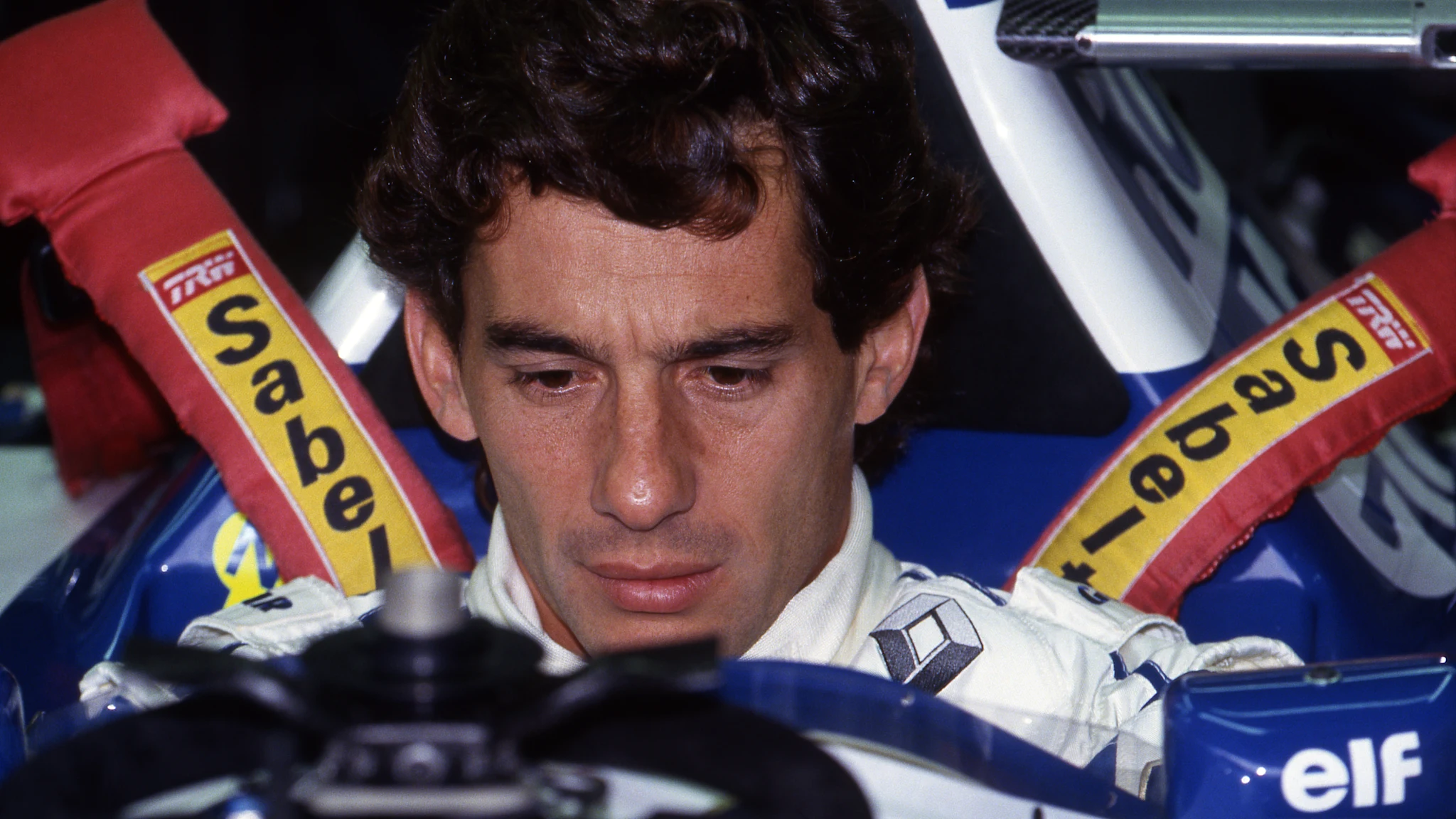
Imola 1994 · Memory into action
The car that changed the sport’s relationship with safety
Formula 1’s official retrospective shows Senna’s damaged Williams at Tamburello. The image belongs here as history, not spectacle: the lasting story is the safety work accelerated by the loss of Senna and Roland Ratzenberger.
Read Formula 1’s Imola 1994 remembranceDamon Hill carried Williams forward with quiet resolve and won the 1996 title. Schumacher changed the job itself: training, testing and debriefing at championship intensity. Todt brought authority, Brawn strategy, Byrne design and Martinelli engines; Schumacher supplied Ferrari’s tempo. The red car became an organization with a pulse rate.
Mika Häkkinen interrupted the renovation beautifully. Behind the reserve was ferocious qualifying speed and wonderfully dry humor. He returned from a life-threatening 1995 crash, won the 1998 and 1999 titles and raced Schumacher hard without requiring a press-conference opera.
1994–2004 · Survival, silver resistance, scarlet empire
The V10 decade had a face for every frequency
This was an era of safety reckoning, wounded courage, McLaren cool and a Ferrari organization beginning to breathe at Schumacher’s tempo.

Roland Ratzenberger · Simtek S941
Photo & licence
Rubens Barrichello · Jordan 194
Photo & licence
Jules Bianchi · Marussia MR03
Photo & licence
Damon Hill · Williams FW18
Quiet persistence, loud achievement.
Photo & licence
Michael Schumacher · Ferrari F2004
An entire organization at qualifying pace.
Photo & licence
Mika Häkkinen · McLaren MP4/15
Quiet voice, wonderfully loud commitment.
Photo & licence
David Coulthard · McLaren MP4/15
Photo & licence
Ralf Schumacher · Williams FW23
Photo & licence
Ricardo Zonta · BAR 002
Photo & licence
Eddie Irvine · Ferrari F310
Photo & licence
Juan Pablo Montoya · Williams FW26
Photo & licence
Kimi Räikkönen · McLaren MP4-20
Lap time in; unnecessary syllables out.
Photo & licence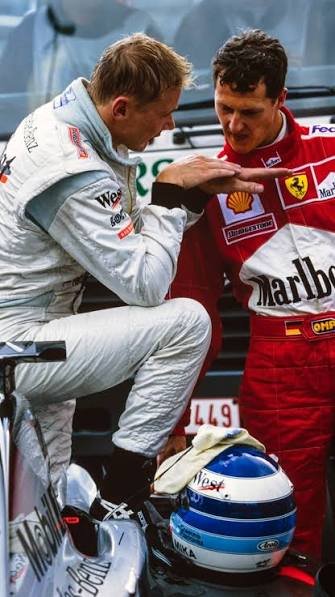
Häkkinen and Schumacher: ferocious at speed, remarkably warm once the helmets came off.
Image supplied by the author.From 2000 through 2004 Ferrari’s V10, aerodynamics, Bridgestones, pit work and Schumacher all arrived at the same answer. Montoya refused to be impressed, Räikkönen rationed syllables and Alonso prepared the next revolution.
XIII · 2005–2013
Alonso, Räikkönen, Hamilton, Button, Vettel—and a grid that would not sit still
Alonso’s blue-and-yellow Renault ended the red reign. His 2005 and 2006 titles joined forceful steering to a deeper gift: reading starts, tires and traffic as one tactical sentence. Give Alonso a fifth-place car and he makes fifth disputed territory.
V10s became V8s. Hamilton arrived in 2007 astonishingly polished for a rookie, raced Alonso level and missed the title by one point; Räikkönen took it for Ferrari. A year later Hamilton found his own championship in Brazil’s final corners. His steering looked light. The consequences never were.
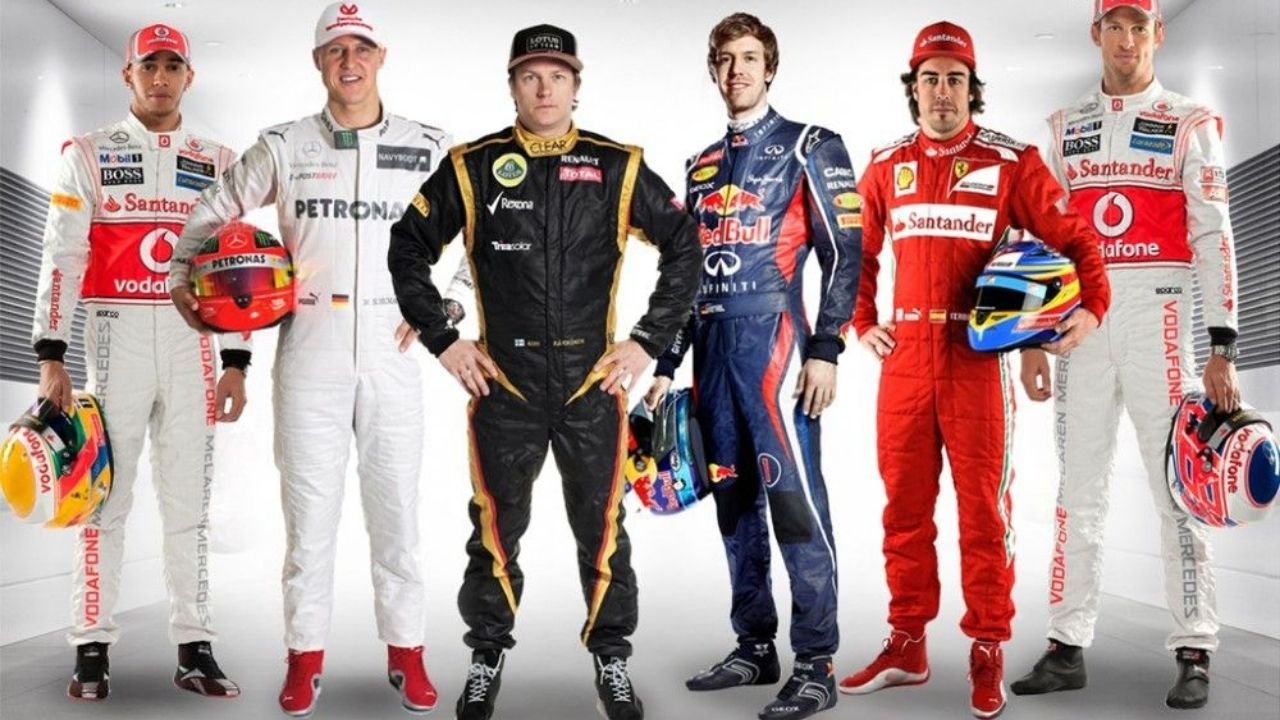
Hamilton, Schumacher, Räikkönen, Vettel, Alonso and Button: six champions gathered at the hinge between eras.
Image supplied by the author.In 2009, Ross Brawn rescued Honda’s team, fitted Mercedes power, found the double diffuser and won both titles in the organization’s only season as Brawn GP. It was Cinderella with wind-tunnel data and a very good lawyer.
Red Bull turned paddock showmanship into substance: Horner organized, Newey shaped the air, Renault supplied the V8 and Vettel supplied pole laps with metronomic cheer. Four double titles followed. Vettel had already made tiny Toro Rosso a wet-Monza winner; now he named cars, celebrated noisily and drove clean air as if it belonged to him.
2005–2013 · The grid refuses to sit still
Blue Renaults, silver rookies, one white miracle and a four-finger dynasty
The Ferrari empire met an unusually crowded generation of champions, rain readers, radio comedians and tactical opportunists.

Fernando Alonso · Renault R25
Every fifth place becomes disputed territory.
Photo & licence
Lewis Hamilton · McLaren MP4-23
A light touch with heavyweight consequences.
Photo & licence
Felipe Massa · Ferrari F2012
Photo & licence
Timo Glock · Toyota TF108
Photo & licence
Jenson Button · Brawn BGP 001
Smooth inputs, improbable white fairytale.
Photo & licence
Sebastian Vettel · Red Bull RB8
Metronome speed, delighted radio.
Photo & licence
Mark Webber · Red Bull RB5
Photo & licence
Vitaly Petrov · Lotus Renault R31
Photo & licence
Pastor Maldonado · Williams FW33
Photo & licenceKERS added electrical boost, DRS opened the rear wing and Pirelli made tire life a plot device. Button’s sensitivity, Alonso’s opportunism, Hamilton’s adaptability and Vettel’s qualifying rhythm became four ways to win.
XIV · 2014–2021
The hybrid masterclass and the speed of a complete system
In 2014 the sound shrank and the puzzle expanded: turbo V6, energy recovery, battery, brake-by-wire and clever software. Fans missed the V10 scream. Fair. The new romance was alchemy—turning yesterday’s wasted heat into speed.
Mercedes solved it first. Brixworth power, Brackley chassis, Wolff’s culture and Lauda’s instinct produced eight straight Constructors’ titles. Hamilton evolved from spectacular passer to tire whisperer and seven-time champion. Rosberg beat him in 2016, then retired days later; apparently Monday had nothing left.

2020 · Hamilton and the W11
Black livery, silver-arrow precision
Hamilton’s smooth speed met Mercedes’ most complete hybrid car in the W11. The partnership made efficiency look expressive: late braking, tire life, qualifying force and a machine that carried both technical and cultural meaning.
Photo: Eustace Bagge · CC BY-SA 4.0 / Wikimedia Commons2014–2025 · Energy recovery, rivalry recovery
Hybrid intelligence still leaves plenty of room for human mischief
Batteries grew clever, braking grew layered and the drivers kept turning invisible systems into extremely visible personality.

Nico Rosberg · Mercedes W05
Photo & licence
Valtteri Bottas · Mercedes W11
Photo & licence
Daniel Ricciardo · Red Bull RB14
Photo & licence
Charles Leclerc · Ferrari SF1000
Qualifying poetry in Ferrari red.
Photo & licence
Romain Grosjean · Lotus E23
Photo & licence
Robert Kubica · BMW Sauber F1.08
Photo & licence
Pierre Gasly · AlphaTauri AT02
Photo & licence
Esteban Ocon · Haas VF-25
Photo & licence
Carlos Sainz · Williams FW47
Photo & licenceFerrari challenged, Ricciardo braked fashionably late and Honda returned to victory with Red Bull. Then 2021 paired Hamilton’s accumulated mastery with Verstappen’s arrival. The ending stayed debated; the brilliance of both drivers did not.
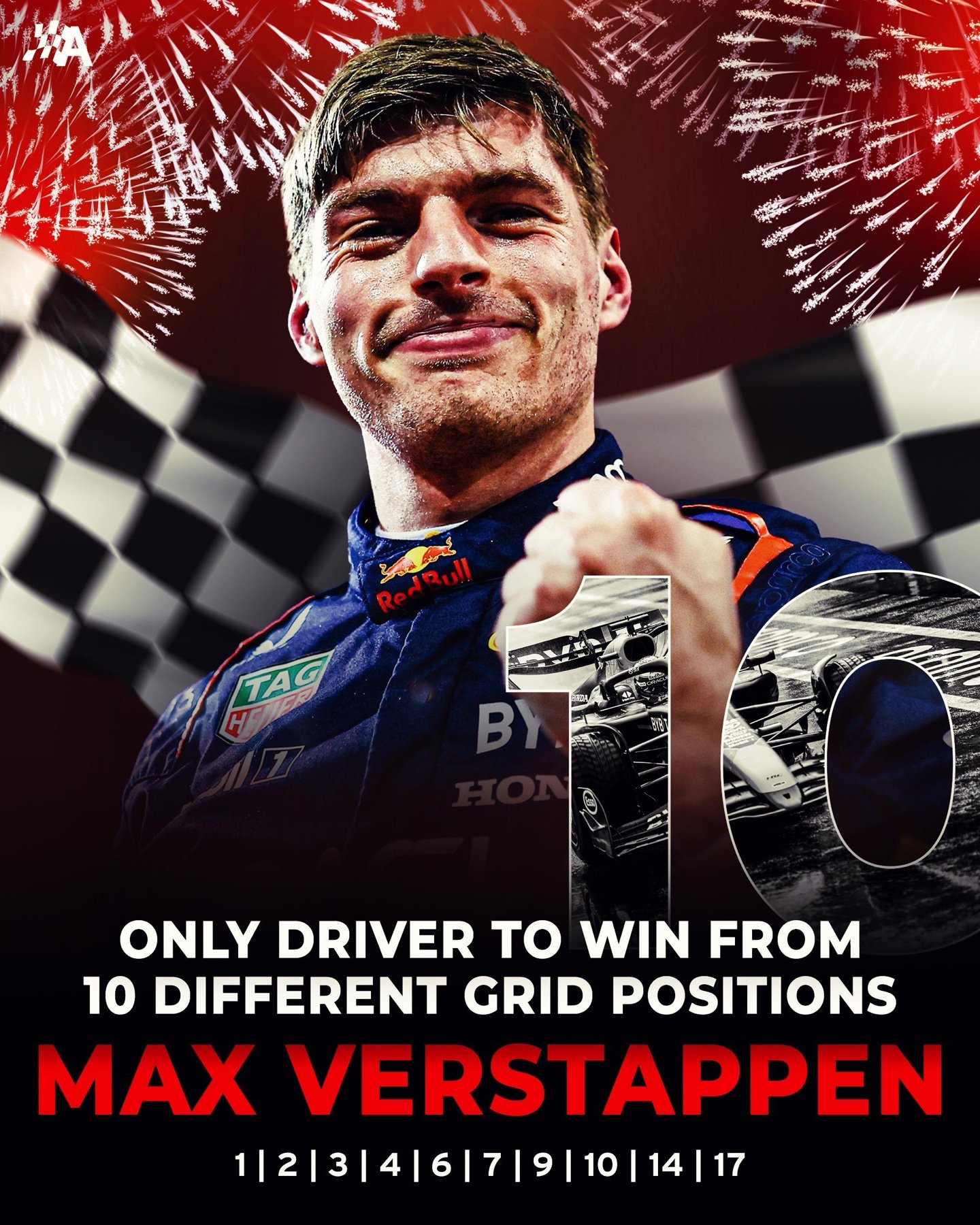
A celebration of Verstappen winning from ten different grid positions: range, recovery and the occasional Sunday that refused to begin neatly.
Image supplied by the author.Liberty Media’s 2017 takeover ended the Ecclestone era. Drive to Survive made the midfield famous, occasionally improved chronology for television and introduced millions to paddock politics. A 2021 cost cap tried to make competitive health less dependent on who owned the largest furnace for cash.
XV · 2022–2025
Ground effect returns, Verstappen dominates, McLaren rises again
Formula One pulled ground effect from the attic in 2022. Shaped floors helped cars follow; the first versions also bounced violently, because air remains unimpressed by simulation credentials. Red Bull understood the platform best. The RB19 won twenty-one of twenty-two races in 2023, and Verstappen’s taste for a precise front end turned Newey’s invisible architecture into relentless, visible command.
Verstappen makes difficulty look like paperwork already completed. Early commitment, rapid correction, tire sense and almost rude adaptability sit beneath the simplicity. He does not decorate the explanation. Usually the stopwatch has already done it.

2023 · Verstappen and the RB19
A driver who commits early, a car that answers immediately
Verstappen’s preference for a decisive front end met a ground-effect platform of extraordinary range. The result was not merely dominance; it was the sensation that driver and car were speaking in very short sentences.
Photo: Lukas Raich · CC BY-SA 4.0 / Wikimedia CommonsMcLaren supplied the counter-story. Brown rebuilt confidence, Stella made calm productive, Norris brought emotional finesse and Piastri compressed his feelings into lap time. Consecutive Constructors’ titles in 2024 and 2025—and Norris’s 2025 Drivers’ crown—proved a great team can rebuild without borrowing another team’s personality. The old flame simply found a papaya lamp.
XVI · Fire, pressure, electrons
What the Formula One engine became
Engine history sounds like a magnificent playlist: straight-eight, V12, DFV V8, turbo V6, V10, V8, hybrid V6. A Ferrari V12 was opera; a 1980s turbo hissed like unstable chemistry; a V10 turned valleys into instruments. Beneath the music, the assignment kept changing: more power, less fuel, smaller package, longer life.
From combustion to orchestration
Four engines, four ideas of progress
The engine story is not a straight march toward more cylinders or more noise. It moves between simplicity, boost, revs, efficiency and electrical intelligence, while the regulations keep changing the definition of a good answer.

Cosworth DFV V8
Compact, affordable and structural: the customer engine that powered an age of independent constructors.
John Chapman (Pyrope) · CC BY-SA 3.0
Renault EF1 turbo V6
The small turbo idea that was mocked, matured and eventually took over the grid.
Hullian111 · CC BY-SA 4.0
Ferrari Tipo 046 V10
A naturally aspirated compromise between the V8’s compactness and the V12’s grandeur—and the voice of an era.
Etienne (Li) · CC BY-SA 3.0
Mercedes PU106 hybrid
Combustion engine, turbocharger, motor-generators, control electronics and battery: no longer merely an engine, but an energy system.
David Merrett · CC BY 2.0The Alfetta made power and drank accordingly. The Cosworth DFV became both engine and structure, giving independent teams a championship key. Ferrari’s flat-twelve placed mass low and charisma high.
Renault’s turbo recycled exhaust into pressure. Early response arrived late; mature boost became overwhelming. Development moved quickly, qualifying engines lived brief, operatic lives and races made fuel arithmetic compulsory. Energy management existed before batteries—it simply sounded more combustible.
After turbo prohibition came V8s, V10s and V12s. The V10 won the evolutionary contest: compact enough, smooth enough, powerful enough and gloriously loud. V8 rules and KERS followed. In 2014 the ‘engine’ became a power unit, with combustion, turbo, battery and recovery systems trading energy under software control.
Fuel is engineered, fingerprinted chemistry; lubricant is invisible performance. Drivers lift and coast, harvest and deploy, turning a regulated stream of molecules and electrons into acceleration. The fastest car no longer burns the most. It wastes the least.
XVII · Before Sunday
The invisible Grand Prix: one team, one clock and a two-second stop
Sunday is the visible tip of a year-round conversation with physics. CFD invents numerical air, wind tunnels test scale models, simulators add a human and dynos prove the machinery. Each supplies part of the picture. Elite engineering begins when prediction and road finally meet.
Aerodynamics buys corner speed with drag and sensitivity; suspension tries to keep the floor in its tiny happy place. Cooling wants openings, air wants smooth bodywork and weight wants everything deleted. A Formula One car is not designed component by component. It is compromise persuaded to cooperate.
Practice turns prediction into evidence. Telemetry offers hundreds of channels; the driver says, ‘the rear goes after the apex,’ and suddenly the numbers know where to look. Setup then chooses the best compromise for this circuit: more wing in corners, less on straights; low ride height until the surface votes otherwise; qualifying sharpness versus race-day kindness.
One team, one car, one heartbeat
A modern Formula One team is a relay race that never hands over a silent baton. The driver feels the car; the race engineer turns sensation into a plan; performance and controls engineers read balance, energy and systems; mechanics build the car and the pit crew rehearses two-second choreography; strategists model tires, traffic, weather and safety cars; the team principal keeps talent, resources and purpose pointed at the same finish line.
The circuit is only one command post. Back at the factory, aerodynamicists compare telemetry with wind-tunnel predictions, reliability engineers watch temperatures and pressures, and a simulator driver can test setup changes while the real cars are being prepared thousands of kilometres away. Logistics, manufacturing, inspection and software support the lap before it exists. Formula One calls this a team because ‘small traveling engineering nation’ would not fit on the entry form.
Then Sunday compresses years into seconds. A strategist may have modeled thousands of race branches, yet must call box before the car reaches pit entry. A driver may spend days learning a corner in simulation, yet gets one instant to decide whether the grip, gap and tire will agree. Four tires can be changed in under two seconds; qualifying positions can be separated by thousandths. The preparation is enormous precisely because the decision window is tiny.
Months to design the floor. Days to model the strategy. Seconds to call the stop. Two seconds to change four tires. One corner to make all of it matter.
Strategy converts uncertainty into probabilities. Simulations run thousands of races; the pit wall gets seconds to identify which one is actually happening. An undercut buys fresh-tire time, a safety car discounts a stop and rain turns every lap into a new contract. Algorithms enumerate futures. Humans select one and own the call.

A race compressed into seconds
The pit stop is a team’s handwriting
A modern tire stop can be completed in less than two seconds, but the choreography begins months earlier: equipment design, repeated human practice, approach speed, wheel-gun reliability, traffic prediction and the strategist’s decision to call the car in at all.
Photo: Bert van Dijk · CC BY-SA 2.0 / Wikimedia CommonsA pit stop makes the organization visible: more than twenty people becoming one creature for roughly two seconds. The speed is only half the achievement; the right tires, the right lap, a clear pit lane and a clean release complete the thought. Behind it, factories manufacture, remote rooms calculate and logistics move an entire small city across borders. The race earns points; the championship travels on preparation.
Formula One is years of work arriving all at once: the design may take months, the decision a second and the winning margin less time than it takes to blink.
XVIII · Companies with memory
Teams, owners, managers and the strange family tree of the 2026 grid
A team can be a manufacturer, founder’s obsession, billionaire’s project or consumer brand—and may try all four before lunch. Names change faster than buildings: Mercedes carries Tyrrell–BAR–Honda–Brawn memory; Aston Martin carries Jordan; Alpine carries Toleman and Benetton; Racing Bulls still contains Minardi DNA.
Ownership decides how long a team can believe. Ferrari sold road cars to race; Bruce McLaren built around practical trust; Williams made independence heroic; Red Bull now owns two teams and a power-unit program; Cadillac arrives with General Motors ambition. Money matters. So does whether it is patient money.
The team principal is chief executive, sporting authority and emotional thermostat. Dennis imposed precision, Todt protected Ferrari, Brawn translated possibility into strategy, Wolff made analysis public and Stella made calm productive. Managers do not drive or design the wing, but they decide how freely every good idea can accelerate through the organization.
Information is the team’s invisible racing line. A mechanic notices an unusual mark, a sensor confirms a pattern, an engineer models the cause, the simulator tests an answer and the factory makes the part. When that chain works, hundreds of specialists speak through one car—and the driver feels the result before the stopwatch names it.
The living grid
Eleven 2026 teams—and the histories traveling inside them
The grid below reflects the 2026 season’s announced drivers, team leadership and power-unit relationships. Ownership descriptions emphasize controlling identity rather than every minority shareholder.
| Team | Lineage and controlling identity | 2026 drivers · leadership · power |
|---|---|---|
| McLaren | Founded by Bruce McLaren in 1963; a historic independent racing organization | Lando Norris / Oscar Piastri · Andrea Stella · Mercedes |
| Mercedes | Works team built through Tyrrell → BAR → Honda → Brawn → Mercedes | George Russell / Kimi Antonelli · Toto Wolff · Mercedes |
| Red Bull Racing | Stewart → Jaguar → Red Bull; owned by Red Bull | Max Verstappen / Isack Hadjar · Laurent Mekies · Red Bull Ford |
| Ferrari | Enzo Ferrari’s Scuderia; the championship’s only continuous constructor since 1950 | Charles Leclerc / Lewis Hamilton · Frédéric Vasseur · Ferrari |
| Williams | Founded by Frank Williams and Patrick Head; owned by Dorilton Capital since 2020 | Alex Albon / Carlos Sainz · James Vowles · Mercedes |
| Racing Bulls | Minardi → Toro Rosso → AlphaTauri → RB → Racing Bulls; owned by Red Bull | Liam Lawson / Arvid Lindblad · Alan Permane · Red Bull Ford |
| Aston Martin | Jordan → Midland → Spyker → Force India → Racing Point → Aston Martin; Stroll-led ownership | Fernando Alonso / Lance Stroll · Adrian Newey · Honda |
| Haas | Gene Haas’s American constructor, competing since 2016 | Esteban Ocon / Ollie Bearman · Ayao Komatsu · Ferrari |
| Audi | Sauber’s Swiss lineage transformed into Audi’s works team | Nico Hülkenberg / Gabriel Bortoleto · Jonathan Wheatley · Audi |
| Alpine | Toleman → Benetton → Renault/Lotus/Renault → Alpine; controlled by Renault Group | Pierre Gasly / Franco Colapinto · Steve Nielsen with Flavio Briatore · Mercedes |
| Cadillac | New General Motors/TWG Motorsports entry; the grid’s eleventh team | Valtteri Bottas / Sergio Pérez · Graeme Lowdon · Ferrari, pending GM power for 2029 |
Names and ownership can change; factories retain memory. A machinist, database or drawing standard may connect a modern car to a team identity several badges old.
2026 · Twenty-two drivers, eleven different answers
The living grid: every helmet, every car, one very crowded first corner
Champions, rookies, rebuilders and opportunity-finders give the new formula its human shape.

Lando Norris · McLaren MCL39
Champion speed, feelings included.
Photo & licence
Oscar Piastri · McLaren MCL39
Emotions compressed into lap time.
Photo & licence
George Russell · Mercedes W16
Photo & licence
Kimi Antonelli · Mercedes W16
Photo & licence
Max Verstappen · Red Bull RB19
Simply—yes—lovely.
Photo & licence
Isack Hadjar · Racing Bulls VCARB 02
Photo & licence
Charles Leclerc · Ferrari SF-25
Maranello hope at full revs.
Photo & licence
Lewis Hamilton · Ferrari SF-25
A new red chapter for number 44.
Photo & licence
Alex Albon · Williams FW47
Photo & licence
Carlos Sainz · Williams FW47
Photo & licence
Liam Lawson · Racing Bulls VCARB 02
Photo & licence
Arvid Lindblad · Racing Bulls VCARB 03
Photo & licence
Fernando Alonso · Aston Martin AMR25
The plot is still not finished.
Photo & licence
Lance Stroll · Aston Martin AMR25
Photo & licence
Esteban Ocon · Haas VF-25
Photo & licence
Ollie Bearman · Haas VF-25
Photo & licence
Nico Hülkenberg · Sauber C45
Photo & licence
Gabriel Bortoleto · Sauber C45
Photo & licence
Pierre Gasly · Alpine A525
Photo & licence
Franco Colapinto · Alpine A525
Photo & licence
Valtteri Bottas · Cadillac
Photo & licence
Sergio Pérez · Cadillac
Photo & licenceAbove them, the FIA governs and Formula One Management promotes; the Concorde Agreement keeps the commercial family at one table. Teams want freedom, the promoter wants spectacle, manufacturers want relevance and the FIA wants safe, enforceable rules. No actor owns the meaning, so meetings resemble constitutional law conducted by people with wind tunnels.
XIX · Geography with consequences
The theatres of speed—and how they learned to protect the actors
A circuit is the third driver. Silverstone is fast and windy. Monaco turns millimeters into reputation. Spa climbs through weather systems that disagree by sector. Monza removes drag and adds nerve. Suzuka carries one error into the next corner; Interlagos is short, bumpy and emotionally combustible. No texture file can reproduce biography.
Four circuits, four temperaments
A circuit is geography edited into drama
The championship began on a converted airfield, became glamorous in a principality, learned to climb through a forest and found a figure-eight proving ground in Japan. A great circuit is not interchangeable real estate; it has memory, ownership and a point of view.

Silverstone
RAF perimeter roads became the home of the first World Championship Grand Prix in 1950.
Steve Knight · CC BY 2.0
Monaco
A narrow civic ritual where precision, proximity and glamour are inseparable.
Niels Mickers · CC BY 3.0 NL
Spa-Francorchamps
Elevation, weather and commitment turn the Ardennes into the championship’s great landscape race.
trolvag · CC BY-SA 3.0
Suzuka
Soichiro Honda’s proving ground became a flowing, technical examination revered by drivers.
Carlos Honda · CC BY 3.0Silverstone kept the speed of its airfield. Monza preserved banking as archaeology. Spa shortened a lethal road course while keeping elevation and forest weather. Honda drew Suzuka as a figure eight; São Paulo folded Interlagos into the land. Monaco remains the glamorous exception: too narrow, too cramped, too potent to judge by overtakes alone. Qualifying there is an art exhibition held beside improbable boats.
Modern circuits use simulation, barriers, runoff, medical access and inspection to make consequences survivable. Safety is not one template: asphalt slows, gravel punishes, both trade benefits. New venues earn character too—Bahrain through abrasion and wind, Singapore through heat and walls, Baku through absurd slipstreams. Keep the cathedrals; welcome new architecture; never assume expensive lighting can rescue an uninteresting corner.
XX · A new formula—and a necessary question
The 2026 debate: brilliant laboratory, or racing by spreadsheet?
The 2026 cars became shorter and narrower, with active wings changing shape between corners and straights. The V6 remained, the intricate MGU-H left and the electrical motor became dramatically stronger. Aerodynamics and battery now negotiate every long straight together.
Advanced sustainable fuel addresses where the carbon comes from, not the existence of an exhaust. Audi entered, Honda joined Aston Martin, Ford joined Red Bull Powertrains and Cadillac began its path toward GM power. Regulations are politics in engineering clothes: they must give several companies different reasons to join the same race.
The fascination is uncertainty. One car may recover beautifully and drag too much; another may deploy early and arrive breathless. Drivers must harvest, spend and race an opponent whose energy state is invisible. It is a new kind of skill, but the audience should not need an electrical-engineering seminar to understand why the car ahead suddenly has no answer.
Has Formula One become too clever to feel fast?
The problem is not batteries or software; cleverness is Formula One’s native language. The problem begins when the decisive contest becomes invisible. If one car passes because its deployment map aligns while the other runs out of electrical help, the grandstand sees motion but not cause. Mystery creates fascination. Too much hidden arithmetic creates homework.
The drivers have delivered a useful verdict in stereo. Several called the lighter, more mobile cars fun; Charles Leclerc also said it was ‘a shame’ when great corners risked becoming more about energy management than pushing. Lewis Hamilton later described accelerating from Stowe and finding no power. After the first races, the FIA reduced permitted recharge and increased available power specifically to reduce harvesting and driver workload. That is regulation working as a steering input rather than a sacred tablet.
But the larger question remains: has Formula One become so regulated that invention arrives with an instruction manual, an appendix and three deployment modes? Governing a safe, sustainable global championship requires rules. A rulebook that dominates the conversation, however, can make the sport feel bureaucratic precisely when it should feel instinctive. Technology has not ruined racing. It must still produce a contest the audience can read and the driver can shape.
The answer is not nostalgia or pretending a V10 could solve international energy policy by shouting at it. Show the battery state, protect flat-out qualifying laps, keep shrinking mass, simplify modes where possible and make the cause of an overtake visible. Formula One need not photocopy its past; it should preserve what every great era shared—clear driver agency, distinctive cars, close competition and enough freedom to astonish the simulation.
XXI · The part that cannot be legislated
The spirit that remains when every car changes
What, then, connects Farina’s Alfa Romeo at Silverstone to a 2026 active-aero hybrid? Not the engine position, cylinder count, fuel, tire, cockpit, business model, calendar or acceptable level of risk. Almost every visible fact has changed. The continuity is an attitude: take the rules seriously enough to find what they forgot to say, take the driver seriously enough to build around human sensation, and take the stopwatch seriously enough to abandon yesterday’s beautiful answer.
Formula One is elegant because performance demands coherence. A car with enormous power and poor cooling is slow. Downforce that destroys the tires is slow. A brilliant driver who cannot explain the car is limited. A perfect strategy executed by a bad pit stop is not perfect. Money without decisiveness can lose to a smaller, better-organized group; inspiration without manufacturing capacity remains a drawing. The sport turns interdependence into motion.
It is natural in a more interesting sense than nostalgic claims about simplicity. The machine negotiates air, heat, friction, gravity, pressure, inertia and human reaction with unusual honesty. Algorithms do not repeal physics; money does not bribe the tire; reputation does not move the braking point. Every lap is a temporary agreement with nature, and every missed apex is nature editing the contract.
It is energetic because the work never stops at the chequered flag. Data travels home before the freight. Engineers compare reality with prediction. Drivers replay moments no camera noticed. Mechanics strip the car. Strategists reconsider the branch they chose. Designers release the next part. Somewhere, a rival has already found two tenths.
And it is fun because seriousness and delight are not enemies. A six-wheel Tyrrell can be both ingenious and wonderfully strange. A fan car can win once and live forever. Rain can turn the best simulation into a suggestion. A rookie can discover confidence in public. A veteran can produce one lap that compresses thirty years of understanding. A pit crew can make twenty people look like one creature. A crowd can recognize a driver by helmet colors before the timing screen confirms it.
Formula One contains ambition at every scale: the driver seeking one cleaner corner, the mechanic one smoother stop, the engineer one truer model and the team one more complete Sunday. It contains craft, trust, memory, recovery and the beautiful human habit of trying again with a slightly better machine. Watch the leader, certainly. Then watch the car competing for tenth, the mechanic leaning over the wall, the front wing flex under load, the driver cool the tires before another attack. The deeper you look, the less the sport resembles cars going in circles. It resembles humanity attempting a lap time.
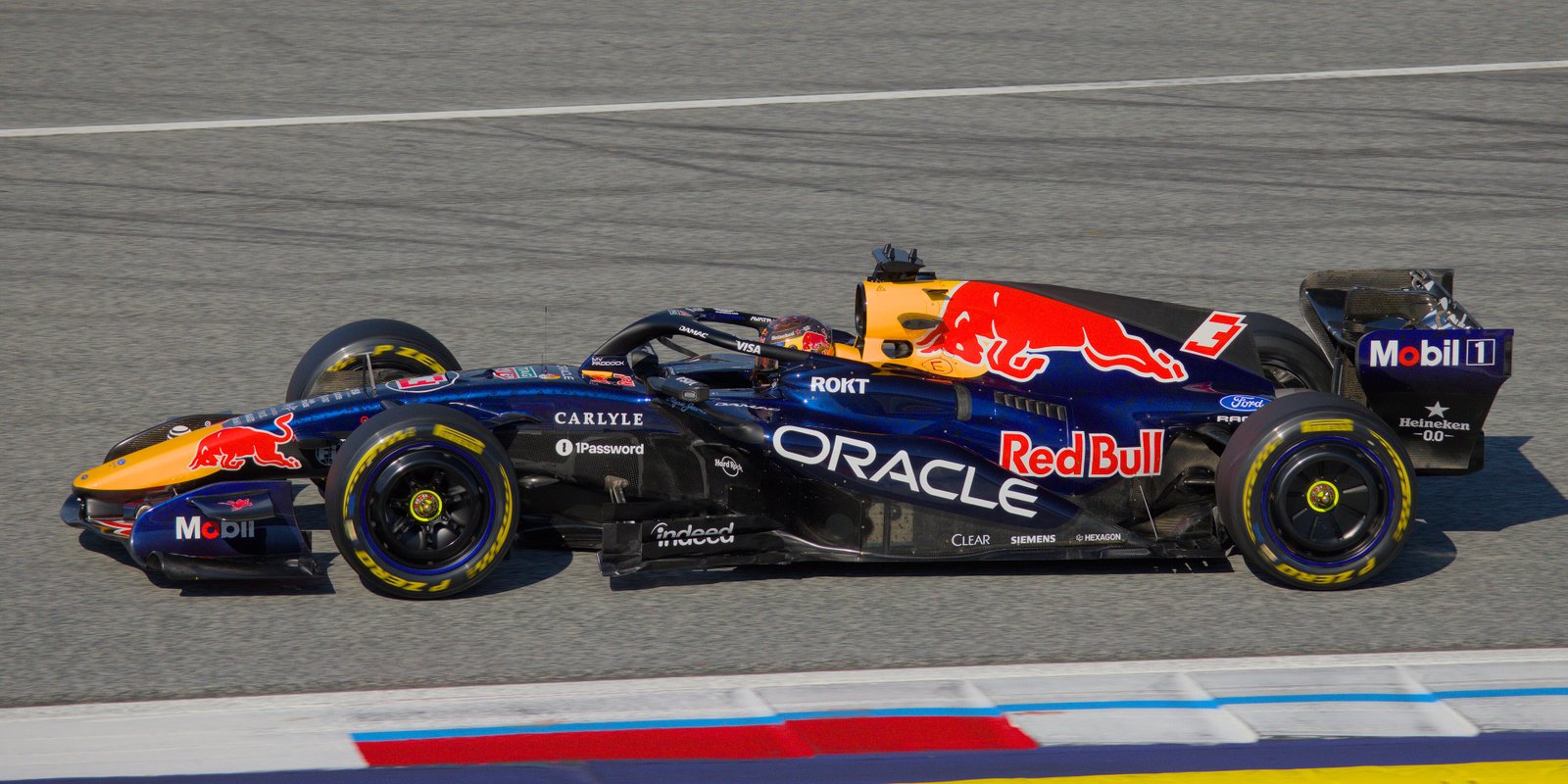
The shapes, systems and eras keep changing. The chase for the next perfect lap does not.
Image supplied by the author.Ten essential sources and further exploration
- Formula 1: 75 defining drivers, cars, innovations, teams and figuresA broad official historical survey.
- Formula 1: Key regulation changes in F1 historyContext for the major technical phases.
- Formula 1: 2025 Global Fan SurveyHow highly engaged fans connect with drivers, teams, racing and storylines.
- FIA: 2026 Formula One regulationsThe current technical, sporting, financial and operational rule documents.
- FIA: How Formula One rules are writtenThe governing body’s rulemaking process.
- Formula 1: The record-breaking 2025 season in numbersOfficial fanbase and live-attendance figures, including 6.7 million spectators across the season.
- Ferrari: Formula One historyThe Scuderia’s own historical archive.
- Red Bull Racing: About the teamThe team’s official account of its disruptive identity and championship development.
- Red Bull Racing: Making the call—strategyHow Red Bull’s trackside and factory strategists turn preparation, live data and judgment into race-winning calls.
- FIA: The safety legacy of Imola 1994Primary safety history and regulatory response.