History did not call Alexander “Great” merely because he conquered. Conquerors had come before him. What separated Alexander was the force with which thought, courage, speed and ambition became one.
The Education of a Warrior
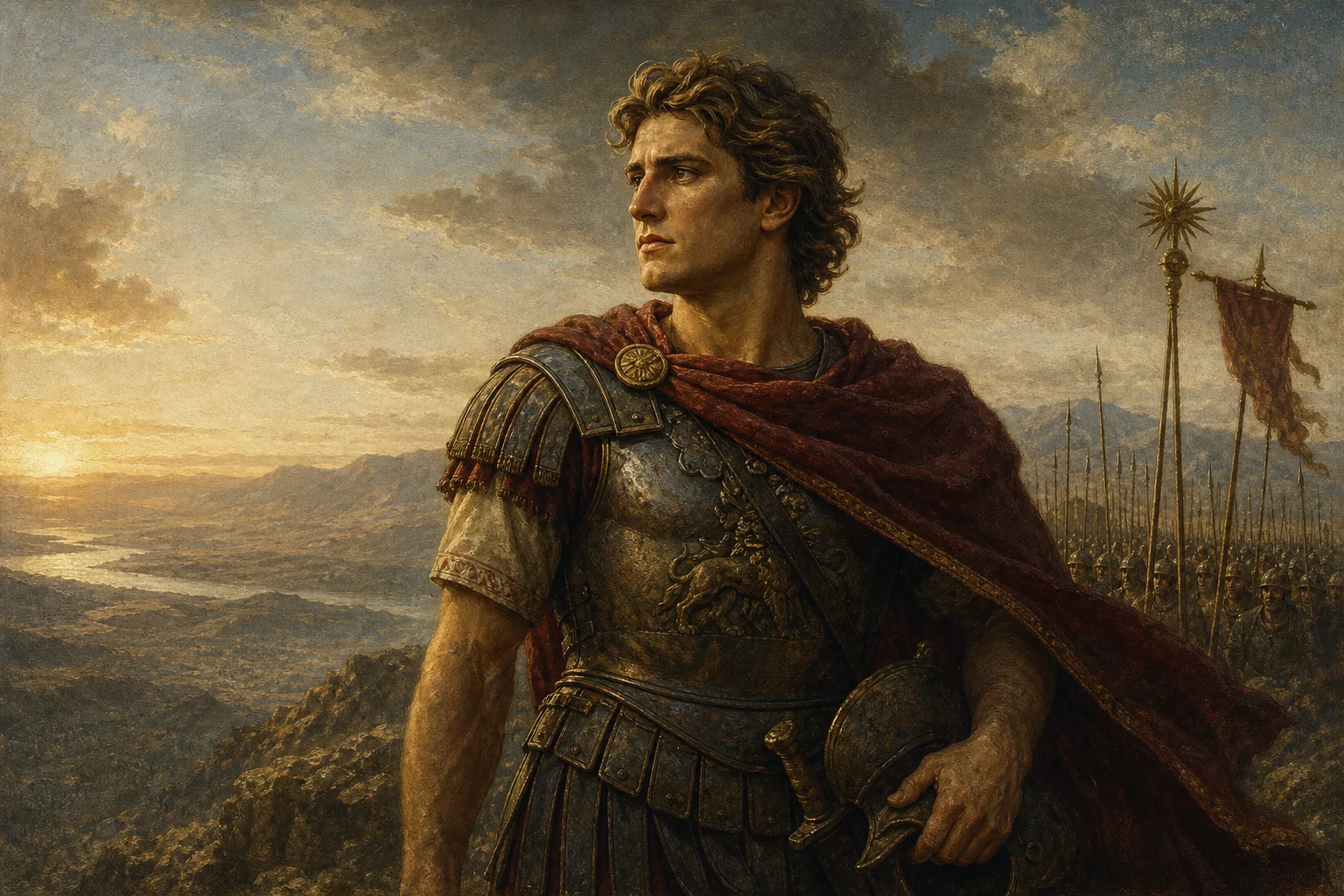
Born in Macedon in 356 BCE, Alexander was shaped by two extraordinary influences. Aristotle educated his mind in philosophy, politics, ethics, medicine and Homer. Philip II, his father, gave him a different school: kingship, discipline, diplomacy and war.
By sixteen, Alexander was governing in Philip’s absence. By eighteen, he had fought at Chaeronea. By twenty, the throne was his. Ancient tradition remembers a young man hungry for distinction—one who admired Philip’s achievements, learned from them, and felt driven to carry his father’s vision farther through accomplishments of his own, exactly as Philip had prepared him to do.
Plutarch’s account of Alexander’s youth captures both his education and his early hunger for achievement.
Aristotle taught him how to think. Philip taught him how to command. But the fire—the relentless desire to test himself against the edge of the known world—was Alexander’s.
The Intelligence Behind the Attack
Alexander’s real genius was not brute force. It was perception.
He studied terrain, formations, morale and personality. He looked for impatience in a commander, fear in a line and pride in a larger force. Numbers could intimidate—but they could also slow movement, stretch command and create overconfidence. Alexander made an enemy’s strength become its burden.
Then he moved.
The phalanx fixed the enemy. Cavalry delivered the shock. Light troops protected movement. Engineers conquered rivers, walls and geography. Feints, decoys and false approaches created uncertainty.
He could threaten several points, pull troops out of position and then concentrate overwhelming force upon the one weakness that mattered. Military studies of his campaigns emphasize his mobility, surprise, economy of force and use of attacks from multiple directions.
Alexander did not need to attack everywhere. He needed the enemy to fear attack everywhere.
Speed was therefore more than movement; it was psychological warfare. He attacked before plans settled, before allies united and before confidence recovered. A maneuver that appeared to be hesitation, withdrawal or a false crossing could become bait—inviting the enemy to advance into exposure.
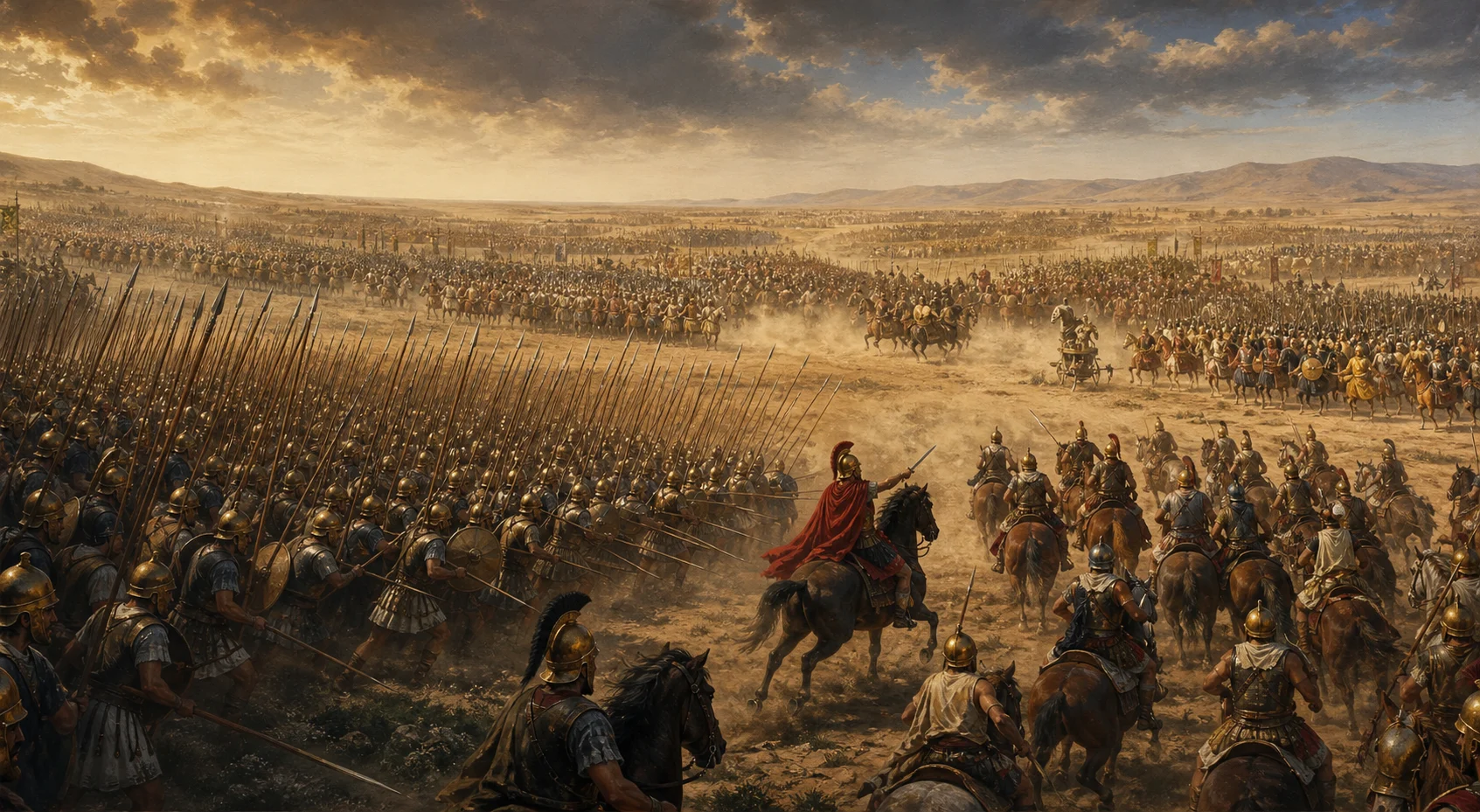
Against a much wider Persian host, Alexander used movement and concentration rather than matching strength everywhere. The phalanx held; the cavalry searched for the opening; the decisive blow went where the line could break. Artist’s reconstruction.
The Commander at the Front
Alexander demanded much because he visibly risked much.
He repeatedly led the decisive cavalry charge and fought where danger was greatest. He was wounded many times. That courage sometimes crossed into recklessness, but it gave his commands unusual moral force: his soldiers saw that he would face the spear he ordered them to face.
His willingness to lead from the front, share hardship and expose himself to danger was central to the loyalty he inspired, although it was also expected of a Macedonian warrior king.
It would be romantic—and false—to say his army cared nothing for pay, plunder or status. Those mattered, as they did to every ancient army. His soldiers eventually refused to march farther at the Hyphasis River when years of campaigning became too much. That refusal ended his eastward advance: Alexander had conquered territory in the northwestern Indian subcontinent, but even he never conquered India as a whole.
Yet their loyalty cannot be reduced to reward. Shared hardship, repeated victory and Alexander’s presence in the front rank created conviction. They were not merely serving a king. For years, many believed they were following the greatest commander alive and participating in something history had never witnessed.
When a Name Became a Weapon
Alexander’s reputation could alter an enemy’s calculations before he appeared.
The destruction of Thebes and the fall of Tyre demonstrated both his ingenuity and the terrible price of defiance. Elsewhere, cities surrendered quickly or without battle—sometimes from fear, sometimes from local politics, and often from both. Byblos, Arados and Sidon submitted quickly; Babylon and Susa were later taken without a major struggle.
His name began to arrive before his army.
That was perhaps his sharpest edge: he defeated imagination before he defeated walls.
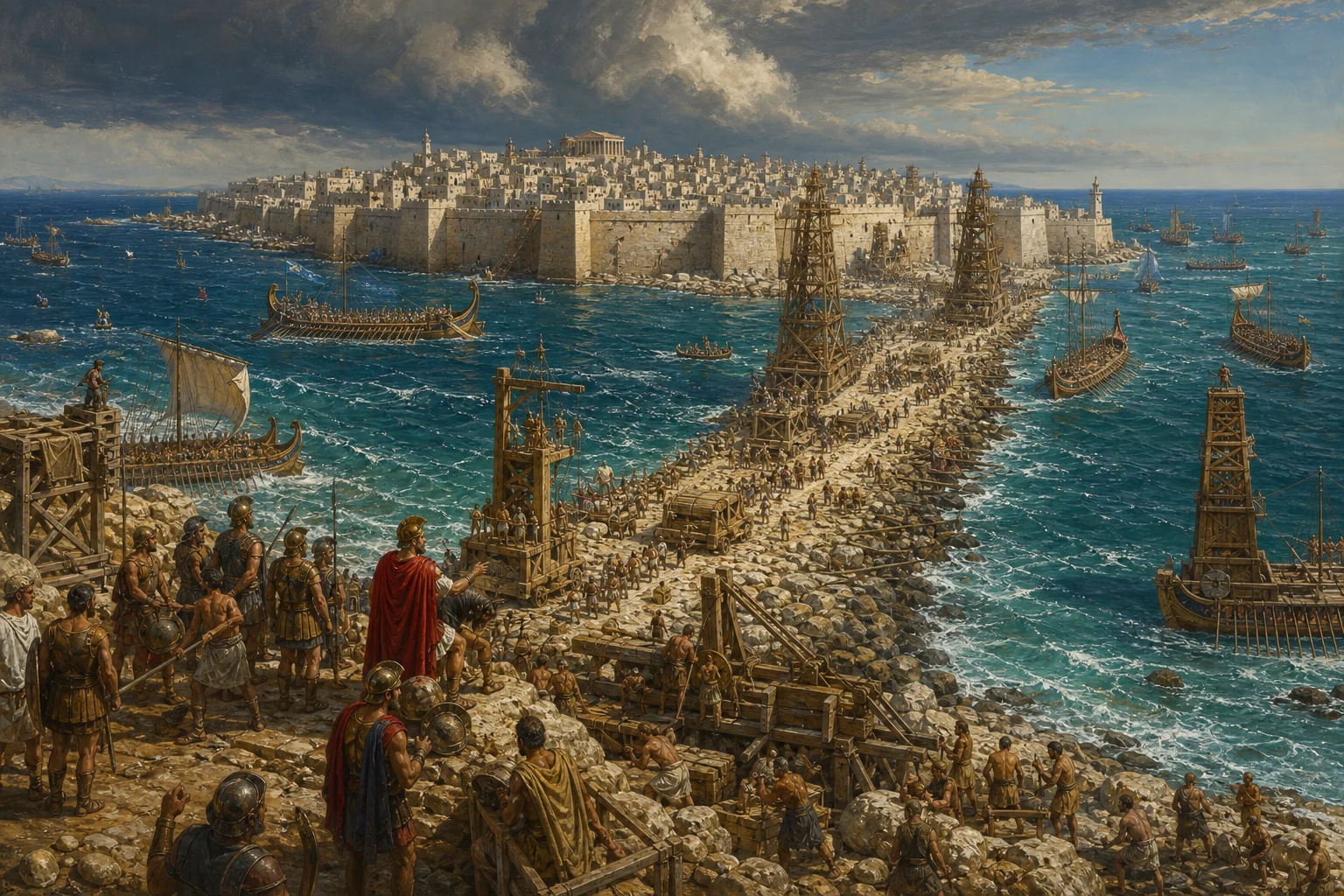
Tyre turned geography into a fortress. Alexander answered by turning engineering into strategy—coordinating labor, timber, stone, siege towers and ships until an island could no longer rely on the sea. Artist’s reconstruction.
The Greatness—and the Shadow
Alexander’s greatness should never be confused with goodness.
His campaigns brought death, enslavement and destruction. Thebes, Tyre, Gaza and other cities paid brutally for resistance. His conquests increased contact between cultures and helped create the Hellenistic world, but that exchange traveled in the wake of violence.
Nor was he a solitary genius. He inherited Philip’s exceptional army, veteran commanders and military reforms. Alexander’s achievement was to use that inheritance with astonishing audacity and adaptability—giving every soldier, horse, engineer and mile of terrain a purpose.
His work was also less durable than his victories suggested. Alexander died at thirty-two. Without a settled succession, his empire fractured among his commanders. He could conquer distance faster than he could build institutions capable of surviving him.
What Made Alexander Great
Alexander was the union of Aristotle’s mind, Philip’s military machine and his own relentless ambition to achieve the extraordinary, surpass known limits and leave a lasting mark on the world.
He read men before he broke formations. He turned speed into surprise, surprise into fear, fear into surrender and personal courage into collective belief.
That is why he remains both heroic and unsettling: a leader brave enough to stand at the front, brilliant enough to bend the world around his will—and human enough to leave behind an empire too vast for any successor to hold.