This is a personal, limited exploration of humanity’s past through science, archaeology, mythology, and theology, written with respect for all religions, cultures, and beliefs. Based on selected books, articles, and research, it is the first in a work-in-progress series inviting open discussion without diminishing anyone’s faith. The interpretations and any errors are my responsibility.
“Let us make humankind in our image, according to our likeness”
— Genesis 1:26
Who is us?
Before we settle into a familiar explanation, let the question stand. Who is being addressed? What does “our image” mean? Why does the making of humanity sound like a conversation?
Religious traditions have thought deeply about divine agency and heavenly councils. Those interpretations deserve respect. They should not make another question inadmissible: could this language preserve an encounter with beings who were powerful, physical, and not human?
The Rig Veda places another question beside it:
“The Gods are later than this world’s production.”
— Rig Veda 10.129.6
If the gods came later, what came before them? The hymn asks who can know how creation began and even leaves its highest observer’s knowledge uncertain. It does not name extraterrestrials. It does, however, make room for a distinction that matters enormously to this investigation: powerful beings within the universe need not be the source of the universe.1
Perhaps the question “Were the gods aliens?” has always been too broad. Which gods? Doing what? Creating existence, changing an organism, teaching a craft, arriving in a vehicle—or appearing in a vision?
A visitor could be understood as a messenger without becoming the ultimate creator. An unfamiliar human civilization could become a divine ancestry. A sacred account could carry historical memory and theological meaning together. And a story could be extraordinary without having begun as an encounter at all.
This investigation follows two trails: what might have happened, and what happened to the record. Could an encounter have been recast as sacred symbolism? Could a capability have survived after its explanation vanished? Could access to its history have been restricted? None of those questions requires us to pronounce a worldwide cover-up before opening the case file.
A clue does not have to disappear to become invisible. Sometimes it only needs an explanation nobody thinks to question anymore. That possibility deserves a harder examination than “ancient people told extraordinary stories.” So does the possibility that we, surrounded by machines, are reading machinery into something else.
My starting position is explicit: ancient contact deserves a serious hearing. So do a lost advanced human inheritance, biological intervention, and the possibility of controlled knowledge. The investigation should be demanding enough to change my mind—and open enough to change the familiar account.
Who were the beings who claimed to make us?
Ancient-contact theory becomes interesting when we stop treating “god” as one job description.
In Mesopotamian stories, divine beings work, complain, delegate, disagree, and take an interest in the manufacture of humans. In Atra-hasis, humanity assumes labor previously borne by gods; earthly material and a divine contribution enter the making. Enki and Ninmah explores bodies, capacities, and the organization of work. A reader thinking about biological intervention can see why these accounts attract attention.2
The speculative reconstruction is formidable: an existing life-form is altered for a purpose by agents whose knowledge exceeds its own. That is a different proposition from saying those agents created Earth, the universe, or life itself.
Fossils and genetics support terrestrial evolution. They do not, by themselves, answer every question about a later encounter or a limited intervention within that lineage. The intervention proposal still has to identify an alteration that natural processes do not adequately explain. But treating common ancestry as proof that no visitor could ever have influenced humanity asks the evidence to settle a different question.
Creation, genetic modification, cultural instruction, and rebuilding after catastrophe are separate possibilities. If an intelligence taught an already capable society a transformative skill, it would not need to manufacture humanity to change its history. Contact might begin with a lesson rather than a laboratory.
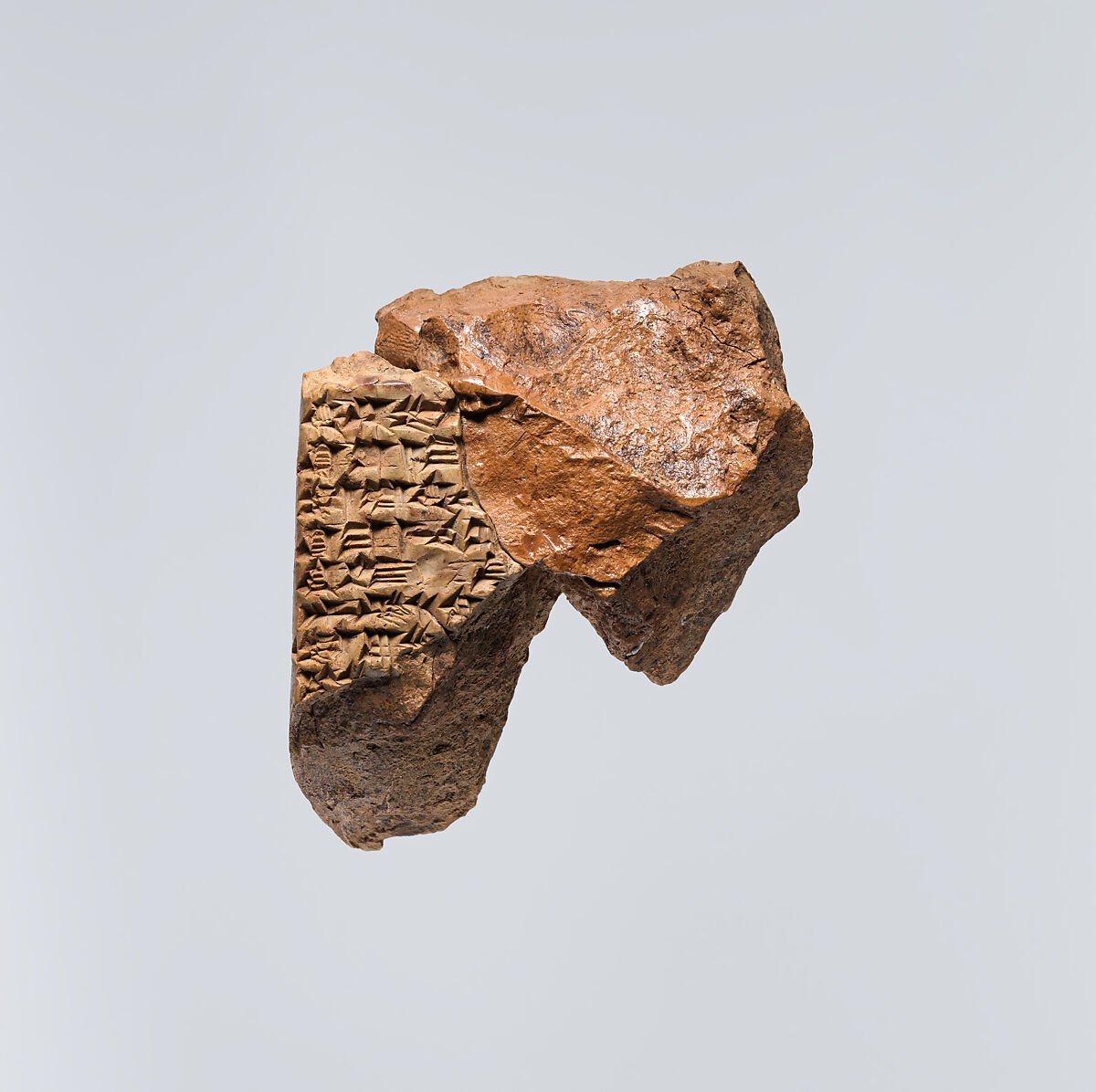
Atra-hasis flood tablet. Source: The Metropolitan Museum of Art.
Who gave humanity dangerous knowledge—and under whose authority?
Genesis adds another disturbing boundary. In chapter 6, “sons of God” take human women; extraordinary figures belong to the resulting narrative. The Book of Enoch expands the world around that episode into descent, relationships, instruction, violence, and judgment. The Watchers agree to an undertaking whose leader already fears its consequences. They teach particular arts. Higher authorities respond when the world deteriorates.3
As a contact story, it resembles an unauthorized expedition with a disastrous transfer of capabilities. The outsiders are not all on the same side. Being able to reach another world would not necessarily make them wise enough to behave well in it.
That is a more demanding alien hypothesis than benevolent visitors handing out civilization. It involves jurisdiction, misconduct, unequal power, and consequences for the recipients.
Yet the story also has a recognizable religious purpose: accounting for violence, illicit knowledge, and the crossing of boundaries. That reading should not be brushed aside. Nor should it prevent us from asking why the narrative gives the crossing such bodily and practical detail.
Why the pact before descent? Why the fear of punishment? Why do particular teachers bring particular arts? The narrative contains a coordinated, prohibited undertaking. That is not yet proof of a historical expedition, but it is more specific than a generic sky myth. A literary explanation should account for that structure; a contact explanation must find evidence beyond it.
Our three modern books pursue different trails through this territory. Chariots of the Gods? foregrounds intervention and the possibility that technical events became sacred narratives. The Book That Will Forever Change Our Ideas About the Bible asks whether embodied divine agents have been interpreted too abstractly. Fingerprints of the Gods pursues a lost human inheritance and catastrophe. The third is not simply another version of the first two: an advanced human predecessor remains a serious alternative to an extraterrestrial one.4
Together they supply questions, not one agreed answer. What kind of agency do the old words describe? What could a civilization lose? What would survivors call someone who knew how to do what they could no longer do?
And who would get the keys?
Who received the vehicle—and who was denied it?
In the Mahabharata, Uparichara Vasu receives a crystal aerial vehicle from Indra. Other mortals do not share his privilege. The episode is embedded in a negotiation over ascetic power, kingship, and duty—not a casual sighting of something passing overhead.5
The vehicle matters. The permission matters just as much.
An advanced-contact reading sees a powerful order granting selected access to a human intermediary. A religious reading sees divine favor, royal obligation, and the consequences of ascetic practice. Both must account for the same relationship: extraordinary capability is not available to everyone on the same terms.
Vasu’s vehicle belongs in the comparison alongside the mobile strongholds Saubha and Hiranyapura, and the Ramayana’s Pushpaka. These are different episodes, not interchangeable aircraft reports. Their repeated conjunction of mobility, inhabitants, permission, and unusual power is precisely what makes them worth examining in full.6
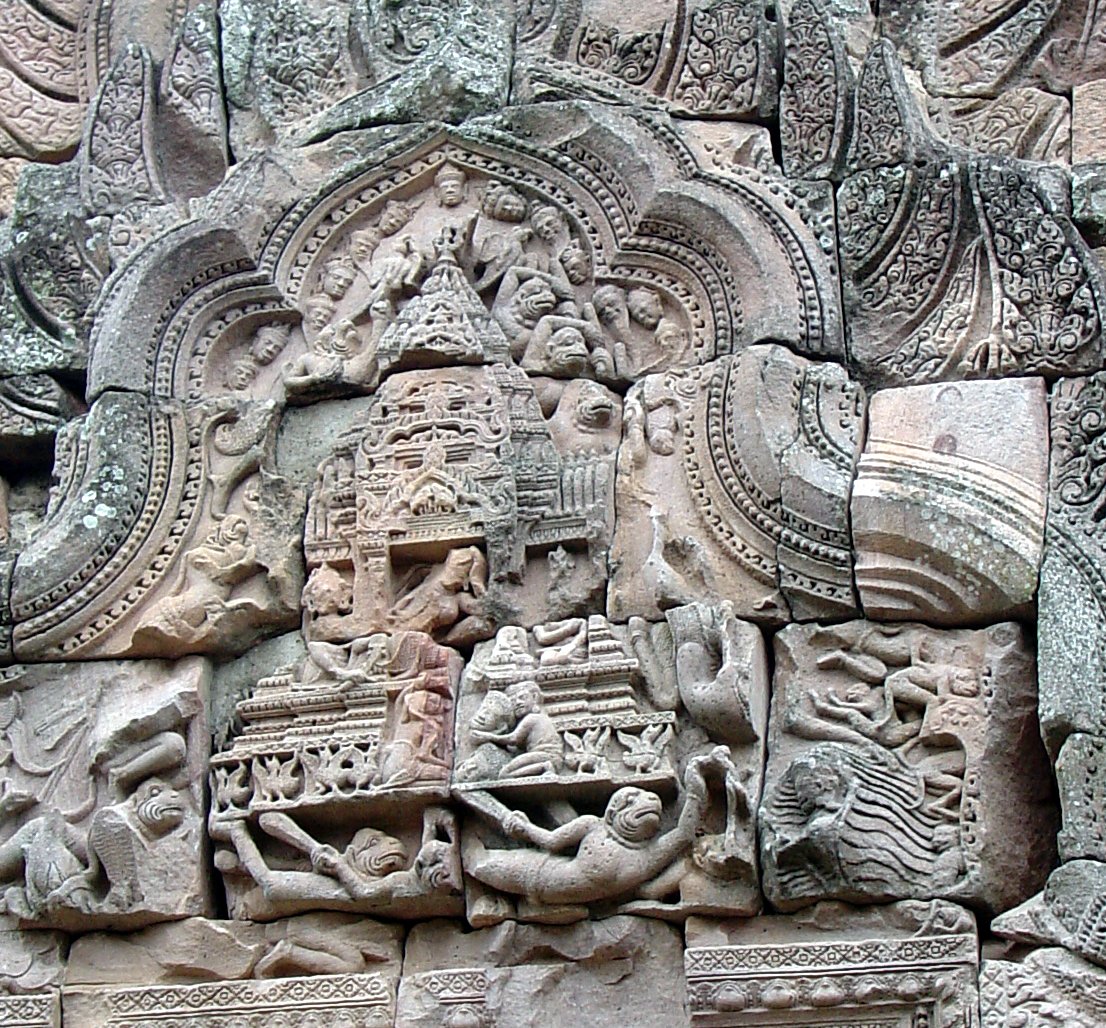
Temple relief associated with vimana interpretations.
Temple imagery gives those questions a visible form. Which scene does a carving represent? Is its architectural form a vehicle, a sacred dwelling, a mountain, or more than one of these in the story? The image’s exact location and identification need verification before its age or meaning can bear an archaeological claim. It cannot authenticate Vasu’s crystal car merely by resembling a flying palace.
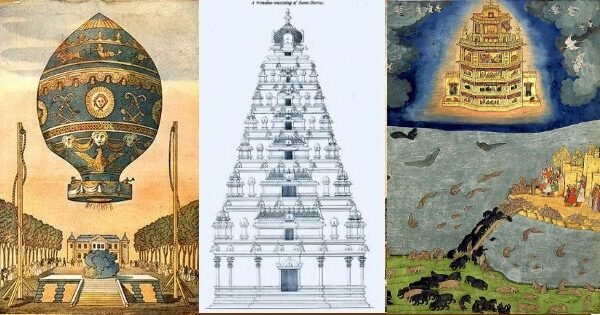
Vimana concept collage — balloon, temple, and flying-palace imagery.
The collage is a prompt for comparison, not one ancient blueprint: it combines different kinds of imagery. The more consequential question belongs to the texts. Why describe a passenger-carrying object, distinguish it from an ordinary chariot, and tie access to a powerful giver? Could that preserve technical memory? If it is entirely symbolic, what does that interpretation explain about the episode’s specific restrictions?
The epic’s weapons deepen the comparison. Named astras have teachers, conditions of use, countermeasures, and consequences when deployed without restraint. Some can be recalled; some threaten far more than their immediate target. A reader familiar with modern weapons systems naturally notices the resemblance to controlled capability, escalation, and operator competence.
It could be the memory of technology expressed in sacred language. It could also be a moral and imaginative account that we interpret through technology because technology is now our language of power. The distinction will not be settled by replacing every luminous weapon with the word “nuclear.” It needs the full passage, surviving textual witnesses, and material consequences that can be dated.
The Vedas add another thread. The Rbhus’ car in Rig Veda 4.36 moves without horses or reins; craftsmanship and renewed youth appear in the surrounding praise. The Atharva hymns describe injured tissues being joined again. The Yajur material preserves procedural continuity; the Sama collection shows how words are carried through performance.7
Craft, movement, repair, and transmission. These are more revealing connections than a collage of bright objects. Could an older technical knowledge survive in ritual forms after its mechanism was forgotten? Could a striking event have been described in the language of the crafts people already knew? Both are worth asking. Neither turns a hymn into a recovered machine manual.
Garuda belongs beside this comparison, but not inside the same mechanical category. A powerful birdlike being is not automatically a constructed vehicle. The distinction prevents flight itself from becoming one enormous, undifferentiated UFO report.

Garuda, Bangkok. Source: xiquinhosilva · CC BY 2.0.
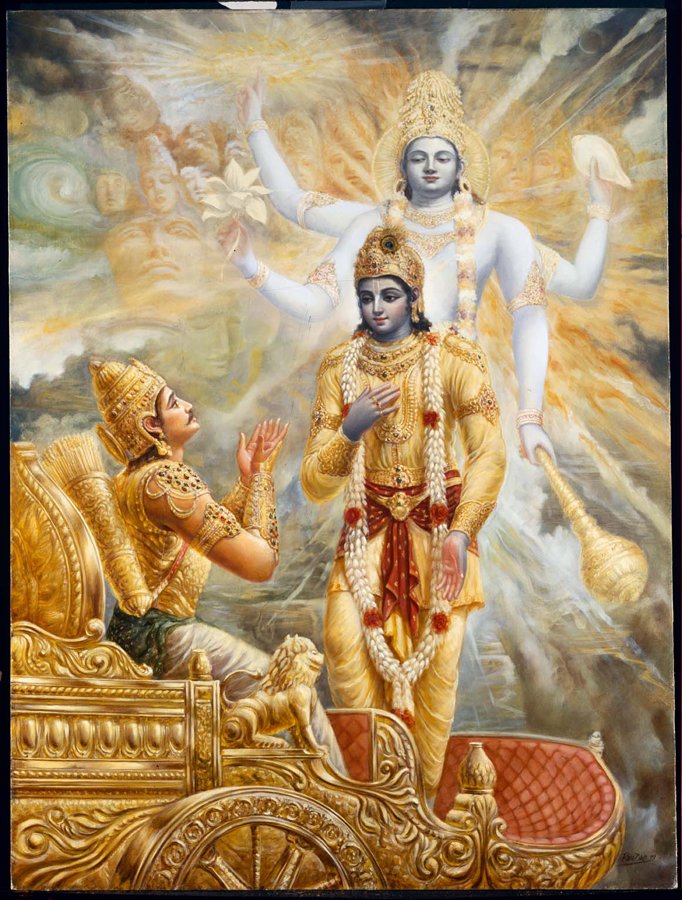
Krishna’s cosmic revelation takes us further from anything that looks like ordinary machinery. In Bhagavad Gita 11, Arjuna confronts a form of overwhelming radiance, faces, worlds, and time. For the believer, this is divine revelation. For a contact-minded reader, it raises the possibility of perception transformed by an intelligence beyond the witness’s understanding.
Could an encounter be experienced rather than merely observed? Could its meaning and its physical cause be different questions? It is possible to ask without reducing Krishna to a device or declaring every spiritual experience a technological trick.
Krishna and Arjuna — the cosmic revelation.
The painting illustrates the account rather than documenting an ancient sighting. The challenge remains in the words: could an unfamiliar intelligence transform what a witness perceived, and could such an encounter acquire a theological meaning without losing every trace of its original character?
Could the machine survive while its history disappeared?
Imagine leaving a working phone in a society that cannot manufacture one. Now remove the charger, the network, the engineer, and several generations of memory.
What survives? Perhaps a dark slab, a story about a face appearing inside it, and an argument over who may touch it. The warranty is unlikely to improve the situation.
This is a thought experiment, not evidence. But it exposes an assumption worth challenging: that a real encounter must survive as a technically accurate description. Why should it? Witnesses describe unfamiliar things with familiar words. Descendants inherit the description without the event. Later readers inherit the words without the descendants’ world.
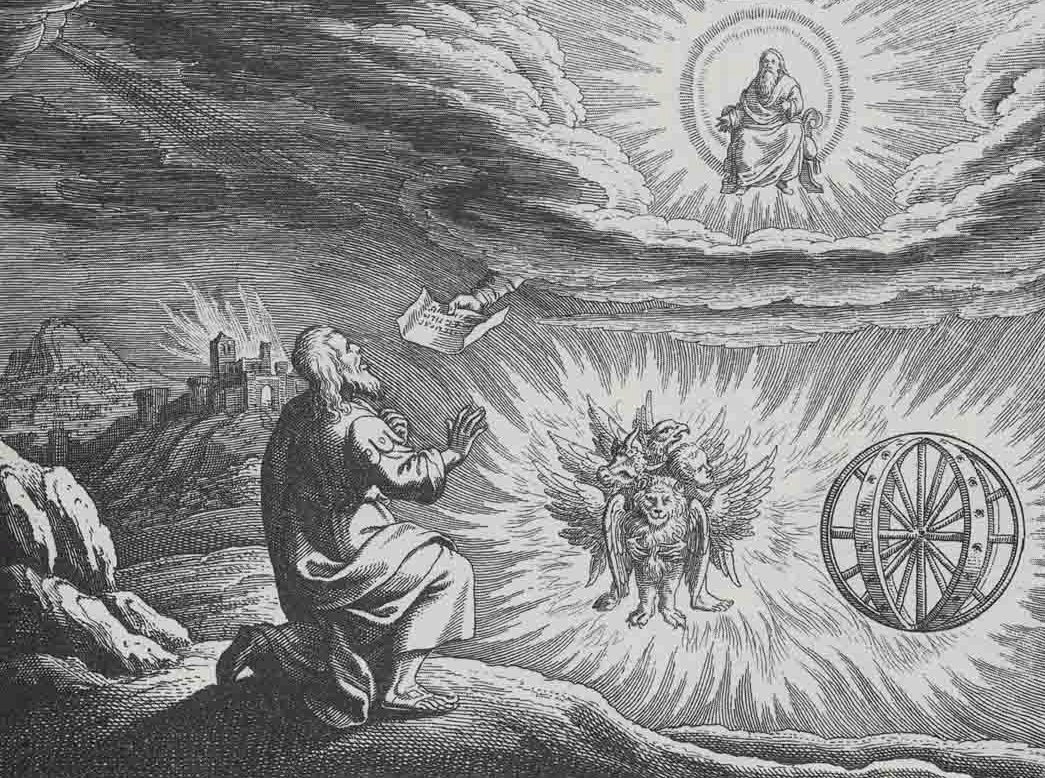
Ezekiel’s vision is a striking place to test that possibility. Fire, luminous cloud, living beings, coordinated movement, wheels within wheels, eye-covered rims, a crystal-like expanse, and a radiant figure appear in one account. It is not simply “a light in the sky.”8
Ezekiel’s vision — living beings and the wheel.
A technical reading sees a coordinated platform, operators, sensors, and motion unfamiliar to the witness. A theological reading sees the mobile divine throne and the possibility of sacred presence beyond its expected place. Chapter 10 identifies cherubim. Those details belong in the comparison, not beneath a convenient label that makes either interpretation unnecessary.
The engraving is a later artist’s rendering, not an eyewitness picture. But the unusual combination in the text deserves more than a label. Which details does a throne-symbolism interpretation explain? Which does a technical model predict? What would distinguish them? Calling the account visionary does not, on its own, identify the cause of the vision.
Star-shaped infrared UAP image.
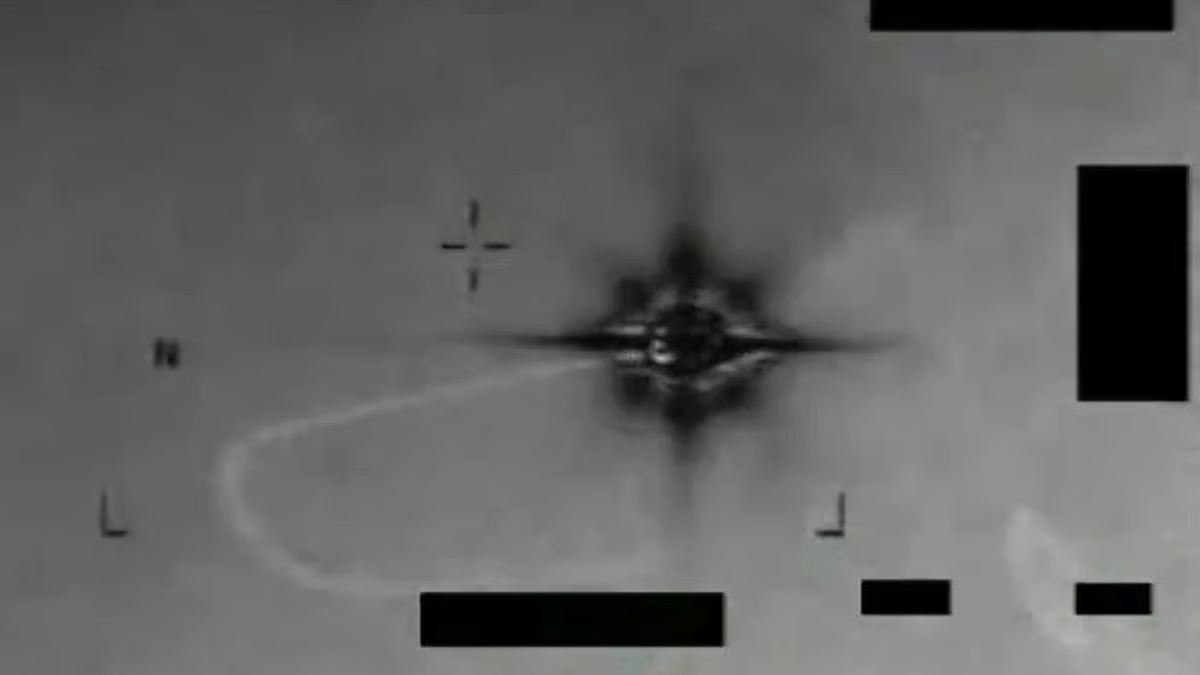
The visual comparison is provocative. The related official 2013 recording describes a star-like contrast pattern and was published in May 2026. Its description does not certify an object’s shape or origin.9 Could wheel-and-fire language and unfamiliar modern aerial forms share a physical cause? Possibly—but sensor effects must be tested before a resemblance becomes geometry, and geometry alone would not identify Ezekiel’s encounter. This image makes the question clearer, not the answer certain.
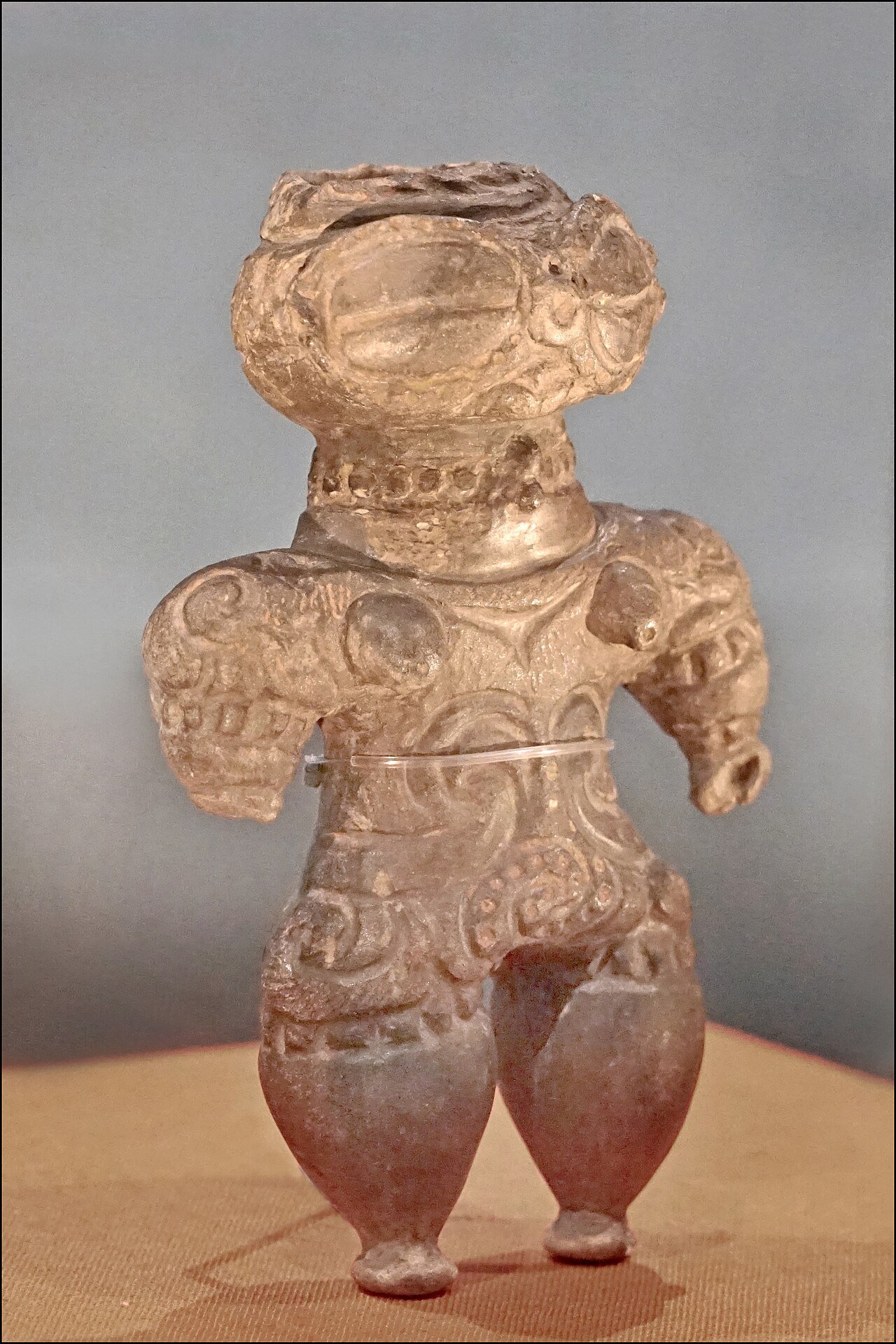
The same challenge applies to the famous visual exhibits of ancient-astronaut literature. Japanese dogū can resemble a suited figure; Assyrian winged beings hold objects that invite technical interpretations; Dendera’s elongated forms can look electrical; Pakal’s tomb lid can resemble a seated operator. Each resemblance opens a question. Its surroundings determine whether the question becomes a case.
Dogū figurine. Source: Jean-Pierre Dalbéra · CC BY 2.0.
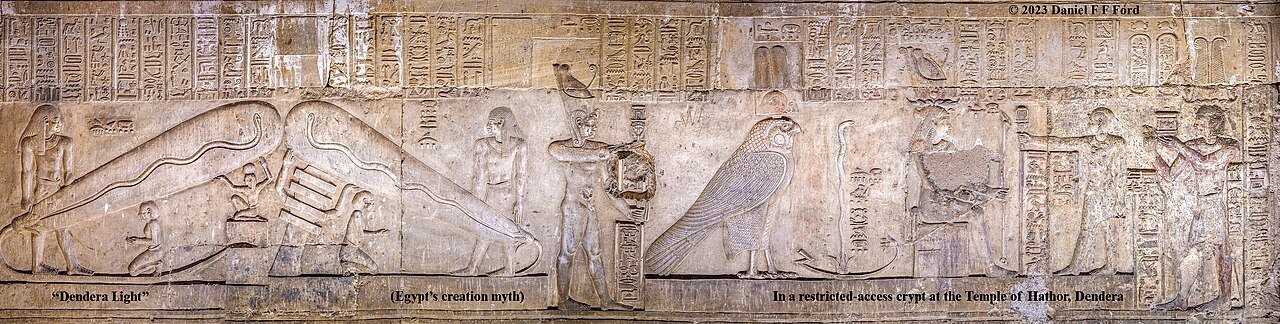
The debated Dendera reliefs. Source: DanielFFF · CC BY-SA 4.0.
A lamp reading at Dendera needs more than a bulb-shaped outline: it needs a plausible relationship between the relief, electrical production, materials, and use. The serpent-and-lotus religious setting is evidence a technical proposal must engage, not a reason to stop looking. Conversely, that setting does not establish that sacred and practical functions could never coexist.
Abydos: a real carving, a disputed aircraft
The “helicopter” at Abydos is not an invented monument. The remarkable shapes are on an actual ancient architrave. Calling the entire object fake misses the issue.
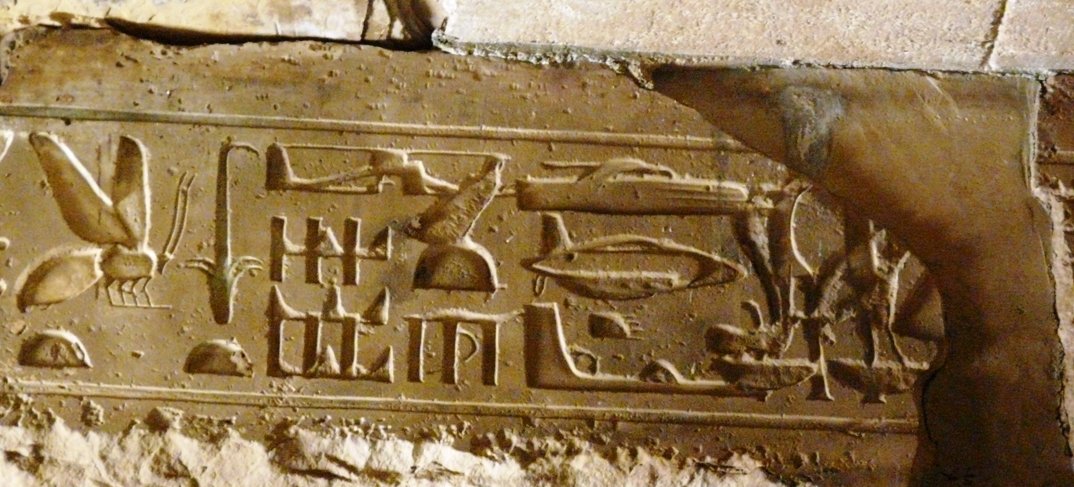
The controversial Abydos carving. Source: Olek95.
The stronger explanation identifies royal inscriptions from Seti I and Ramesses II overlapping on the same surface. Parallel inscriptions in the temple allow the earlier sequence to be reconstructed. Recutting and damage produce the aircraft-like forms. That is evidence about the inscription, not merely an appeal to an expert’s title.10
There is room to examine the reconstruction, including the fact that popular skeptical diagrams have not always been accurate. But an intentional aircraft drawing must explain the full surrounding text and the matching royal formulae. A convincing silhouette is not enough.
So: authentic relief, controversial visual interpretation, strong contextual evidence against this particular aircraft reading. It need not carry the entire ancient-contact theory on its rotor blades.
Its other lesson is genuine. Ancient people did alter what a monument said. Here the recoverable change concerns royal identity; we have no evidence that it concealed visitors. The record can change without every change having the same motive.
Who decided the pyramids were a closed case?
At Giza, the question is larger than “Could humans stack stones?” The questions concern planning, transport, internal design, the relationship between sacred purpose and architecture, and how much of the complex remains unexamined.
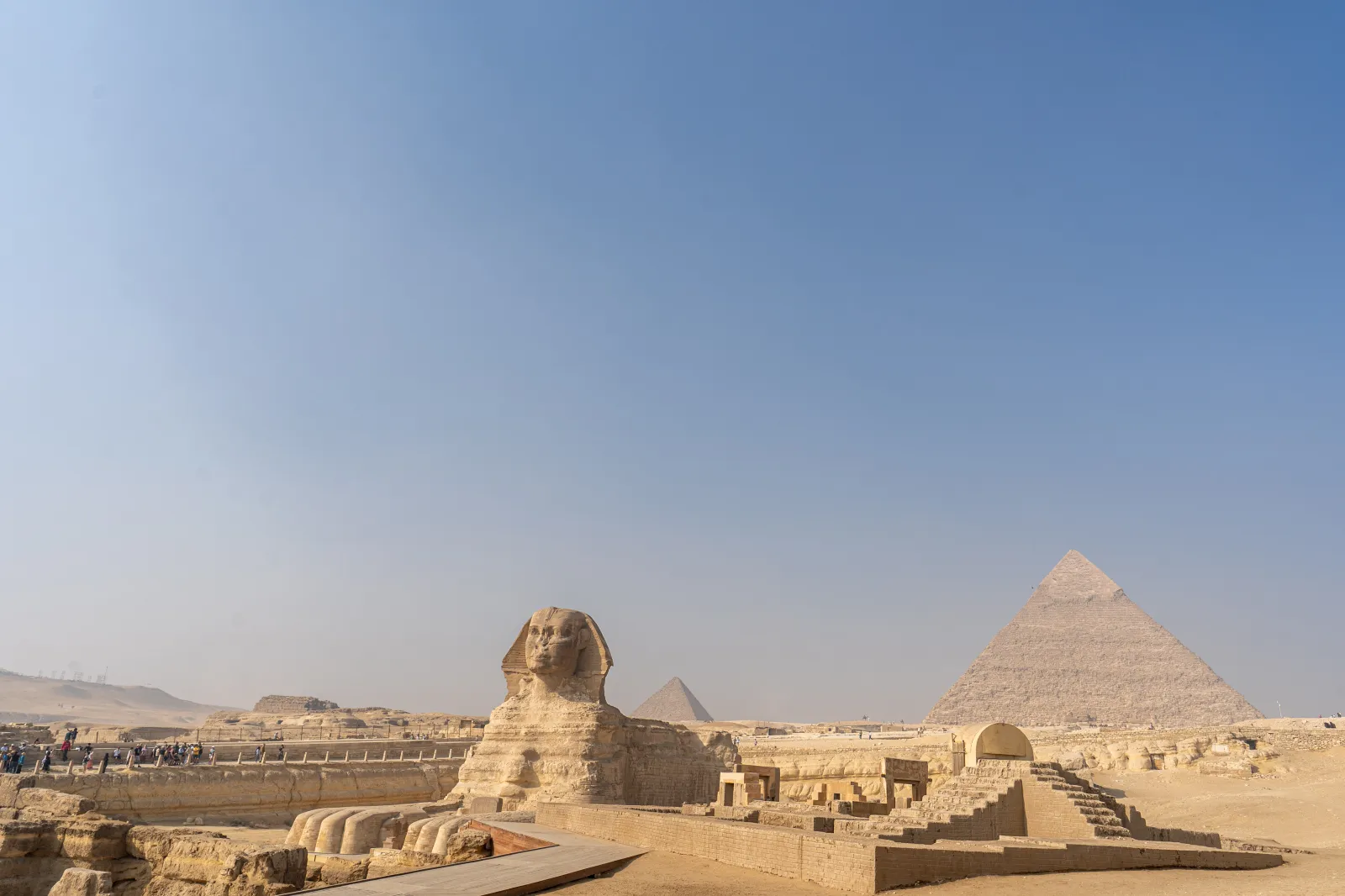
The Sphinx and pyramids, Giza.
There is substantial evidence connecting the Great Pyramid with Khufu’s Egypt and a human building project. That evidence matters. It does not reveal every decision, every construction sequence, or the contents of every inaccessible space.
A transport diary is not a complete construction manual. A funerary context is not a measurement of every possible function. The critique is not that Egyptian achievement should be erased. It is that identifying the builders should not become a substitute for explaining the engineering—or investigating where their knowledge came from.
Muon imaging established the Big Void in 2017; later work characterized the north-face corridor. Further investigations continue to refine the interior map. Hidden architecture is not an internet invention.11
What is inside? Why that geometry? Could a chamber reveal an unfamiliar ritual, an archive, or a technical function we have not recognized? These are legitimate questions. The power-plant, resonator, astronomical, and inherited-knowledge proposals should state what measurements would favor them over known Egyptian uses.
At Saqqara, the Serapeum raises the engineering question underground. Its monumental stone sarcophagi belong to the burial tradition of the sacred Apis bulls. That association is real evidence, not a disposable inconvenience.12
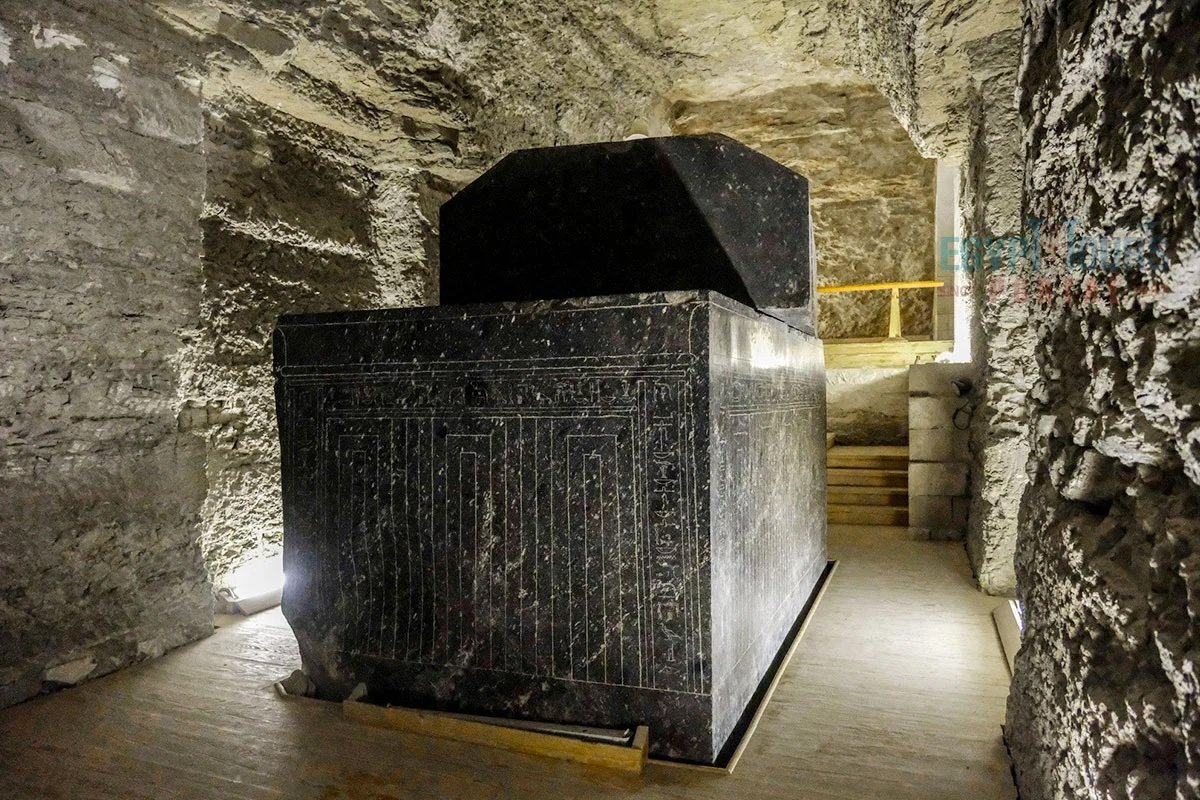
The monumental stone sarcophagi of the Serapeum, Saqqara.
But naming a burial use does not reconstruct how each enormous box was hollowed, finished, moved, and installed. Claims of extraordinary precision should be measured rather than admired from photographs. Proposals of resonators, inherited machines, or repurposed technical containers should predict wear, residues, or features that the burial interpretation would not. Could an older capability have been reused? The question is worth asking; an attractive surface is not yet the answer.
The enormous underground Khafre claims need a different label. The publication used to support the satellite method was retracted in August 2026. That is a serious reliability change, not an excavation confirming—or physically refuting—every proposed shaft. Independent measurements remain necessary.13
The same distinction travels well. At Puma Punku, impressive worked stone warrants close engineering analysis, not a declaration that local people were incapable. At Nazca, new surveys continue to add figures to a landscape whose meaning remains debated. The sky-facing scale can invite an aerial audience, but an aerial audience could be imagined, divine, ceremonial, or physical. It need not have required a runway.14
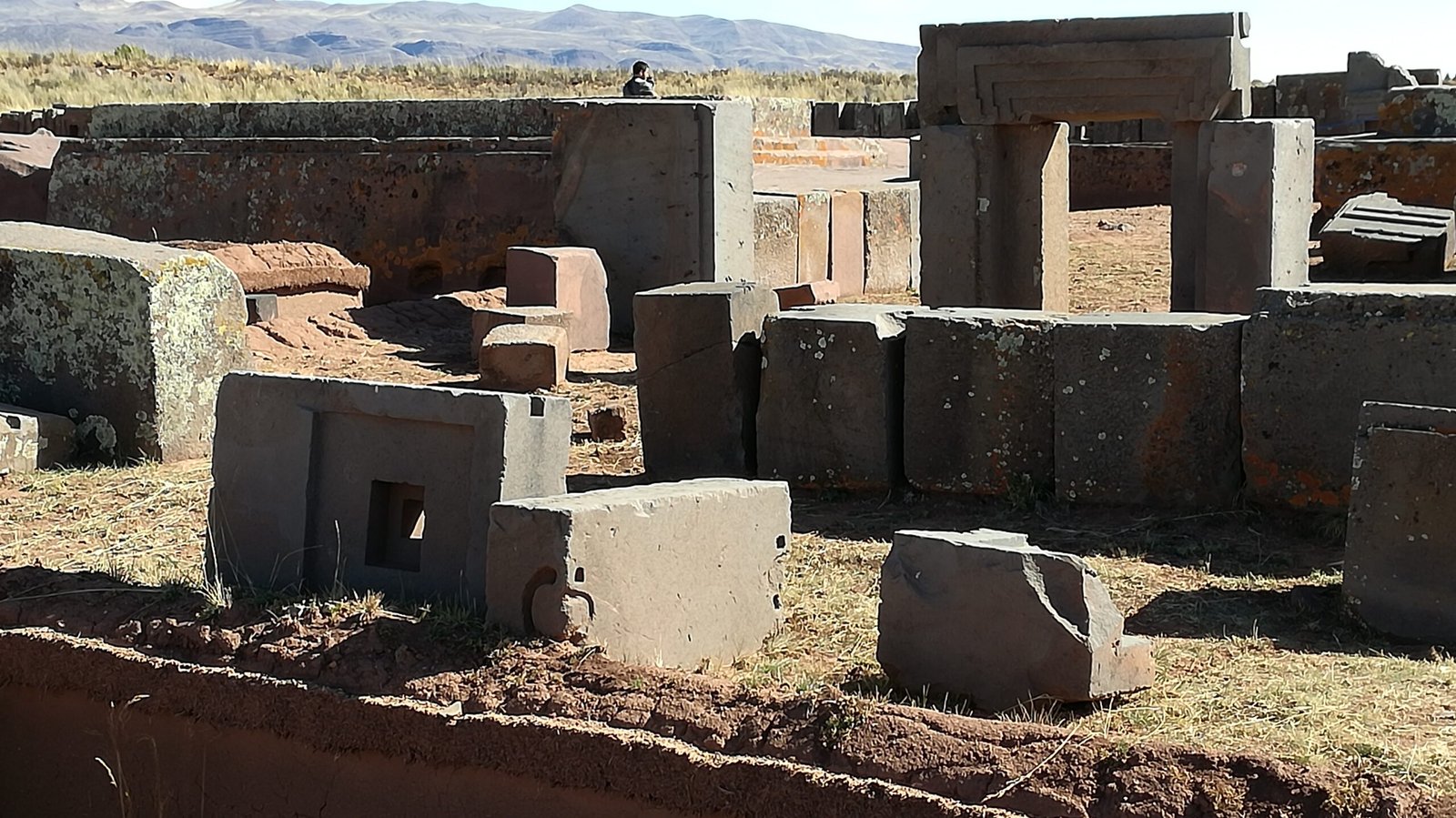
Puma Punku stonework. Source: Benjamin Burga · CC BY-SA 4.0.
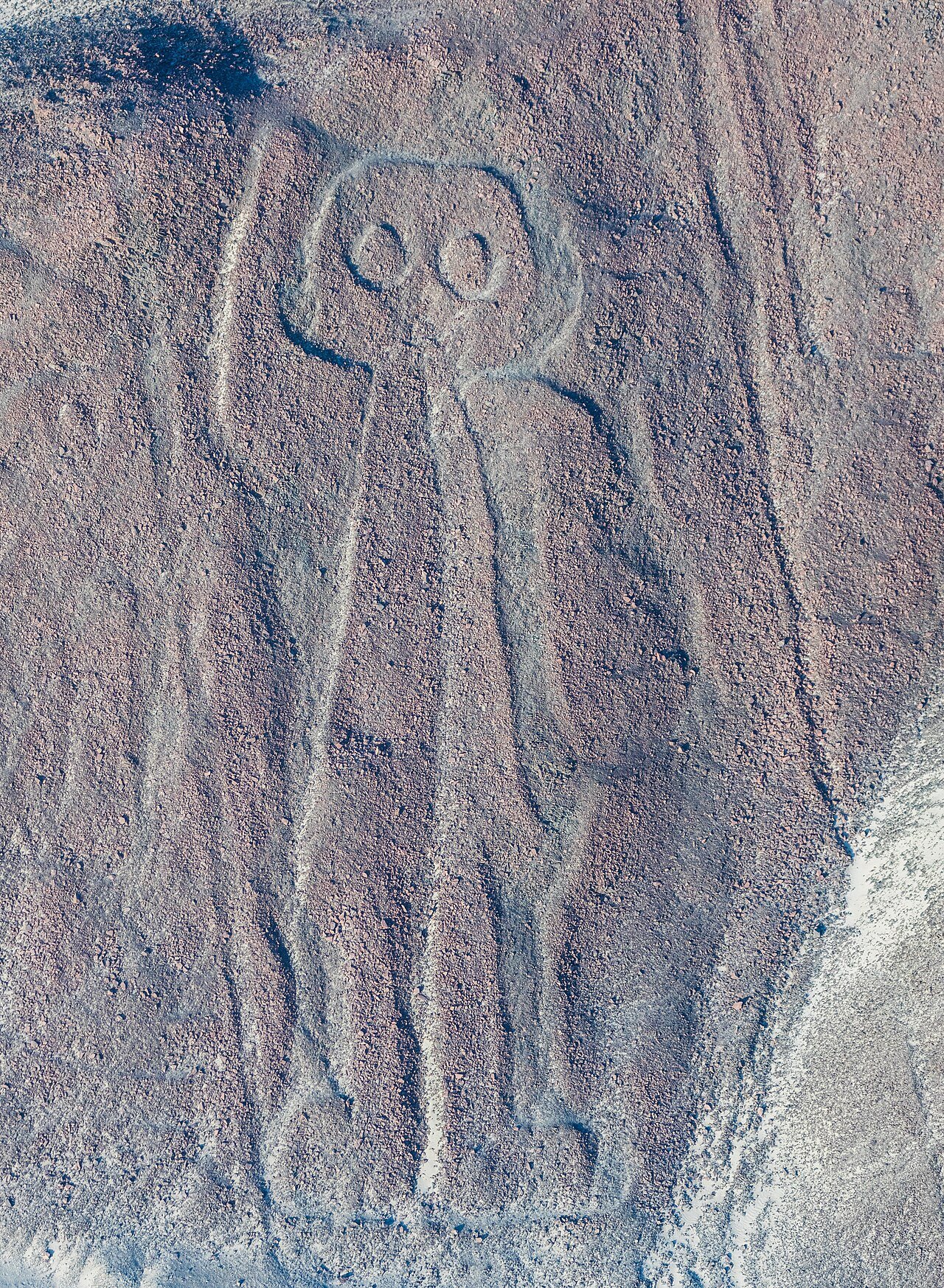
Nazca’s often-called “Astronaut” figure. Source: Diego Delso · CC BY-SA 4.0.
Machu Picchu puts the engineering question at eye level: fitted stone rises from living rock at the Temple of the Sun. Did its builders inherit techniques whose full transmission we have yet to recover? That is worth asking without declaring the Inca incapable of their own architecture. Radiocarbon work places occupation around 1420–1530, earlier than a familiar documentary chronology.15 Even an iconic site can make the written history change. A claim of outside instruction would need something more distinctive than beautiful masonry—but should we be looking for that missing signature?
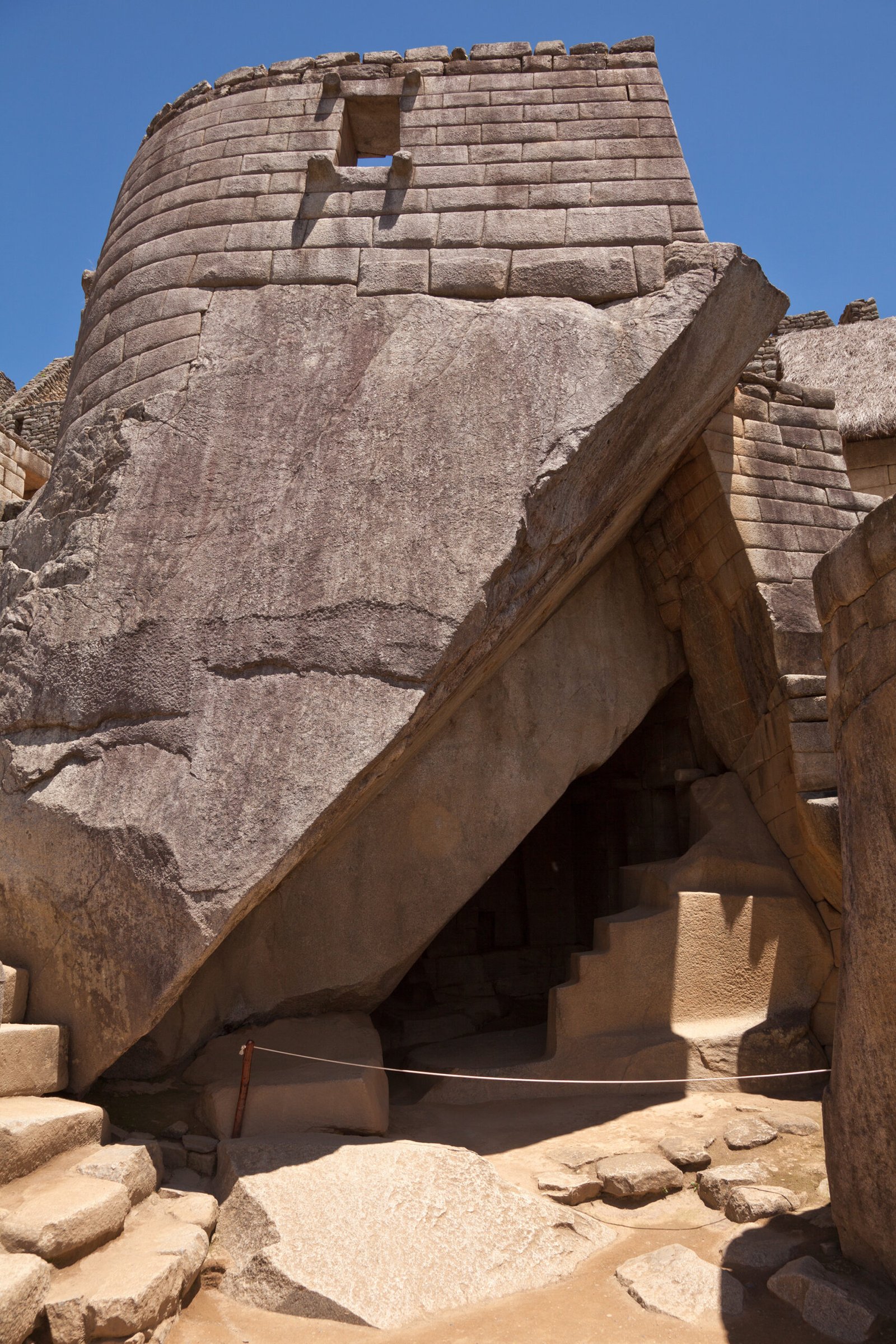
Temple of the Sun, Machu Picchu. Source: Unukorno · CC BY 3.0.
The Indus civilization presents another kind of silence: cities, drainage, standardized practices, seals—and writing whose interpretation remains unresolved. We can inspect what survives while lacking access to much of what its people might have said about it.16
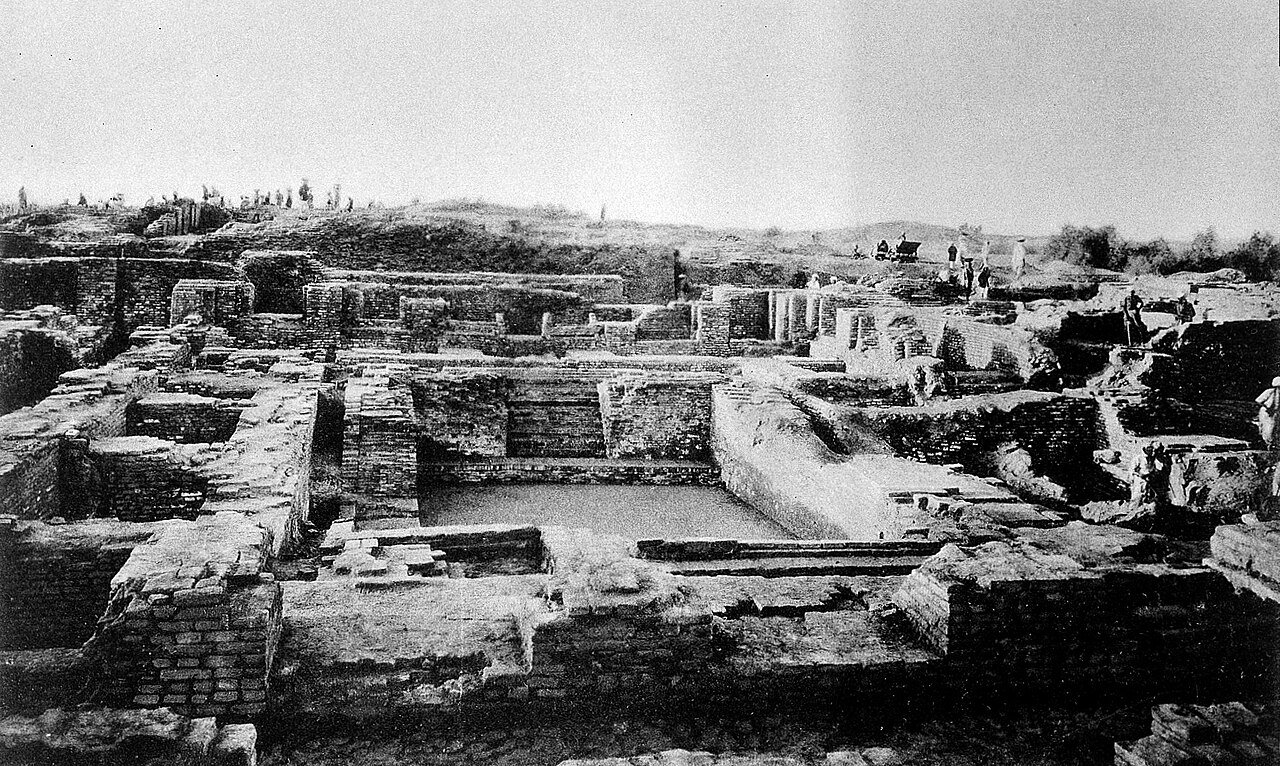
Mohenjo-daro excavation. Source: Wellcome Collection · CC BY 4.0.
That silence is an opportunity, not a blank cheque. A decipherment might reveal very human institutions. It might change our understanding of religious beings, authority, or knowledge. Claims of a nuclear destruction at Mohenjo-daro need dated, independently measured signatures; the city’s mystery does not supply them by itself.
The intriguing possibility is not that humanity built nothing. It is that capable humans might have encountered something still more capable—and built their own civilization around part of that encounter.
What if the missing chapter is underwater?
Much of the landscape our ancestors inhabited no longer looks like their world. Sea-level rise drowned shelves, estuaries, and coastlines. Erosion, sediment, forest, and later settlement conceal other traces. An empty map is not the same thing as an empty past.
Göbekli Tepe made early monumental organization harder to fit into simplified stories about civilization’s beginnings. Worked wood at Kalambo Falls extended the material evidence for very early construction. White Sands footprints forced a renewed discussion of American settlement dates. LiDAR in the Upano Valley revealed a substantial ancient human-built landscape beneath forest.17
These discoveries do not establish alien builders. They establish something important to the debate: our inventories and expectations can be incomplete enough for major discoveries to change them.
The chronological differences matter. Early woodworking is not an industrial civilization; an older footprint is not an older city. Nor should a discovery in one region automatically validate a lost worldwide network. The real lesson is more useful: identify where our methods and preservation conditions leave gaps, then search them.
This is where the lost-civilization argument has particular force. A sophisticated maritime or astronomical network could leave a different record from a global industrial empire. It might survive through scattered recipients rather than intact factories. A limited extraterrestrial visit would leave different traces again.
Would we recognize each kind of evidence—or keep testing the easiest version to reject?
Noah and Manu: warnings before the world changed
In Genesis 6–9, Noah receives instructions to build a vessel and preserve his family and animals; the Ark eventually rests in the “mountains of Ararat.” Mesopotamian flood stories also connect warning, survival, and rebuilding. In the Mahabharata, Manu preserves seeds and seven sages under extraordinary guidance. The intriguing connection is planned continuity: who knew catastrophe was coming, and how was that knowledge passed on? Divine care, remembered disasters, an advanced human refuge, and outside assistance are different readings worth examining.18
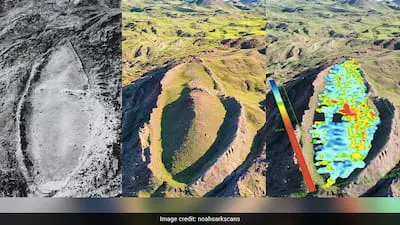
Durupınar — site photographs and scan visualization; disputed Ark candidate.
The Durupınar site in Türkiye remains under investigation. The project announced core drilling and sample recovery in September 2026, with further analysis pending, and now claims organized features beneath the surface. This is an ongoing search, not an excavated and authenticated Ark. The composite above combines landscape views with an interpreted scan; it is not a photograph of a buried vessel. Geological explanations remain substantive competitors. There is no independently established proof here that the formation is Noah’s Ark.1920
It is nevertheless worth following. A securely dated constructed vessel would change the debate; a natural formation would close this candidate, not every survival tradition. Neither result alone would establish alien assistance. The harder question remains whether some survivors received knowledge beyond their own capabilities. Preserving and repopulating an existing world is also different from seeding the first life or creating humanity.
Who controlled the surviving story?
Nobody has been shown to control humanity’s entire story. But rulers, scribes, religious custodians, museums, and governments have controlled particular parts of it. An archive need not burn for its contents to become inaccessible; an interpretation can become authoritative before outsiders see the evidence.
Hatshepsut’s damaged and reassembled statues give altered royal memory a physical form. Their fragments preserve a history of change, although damage and reuse cannot all be assigned one motive.21
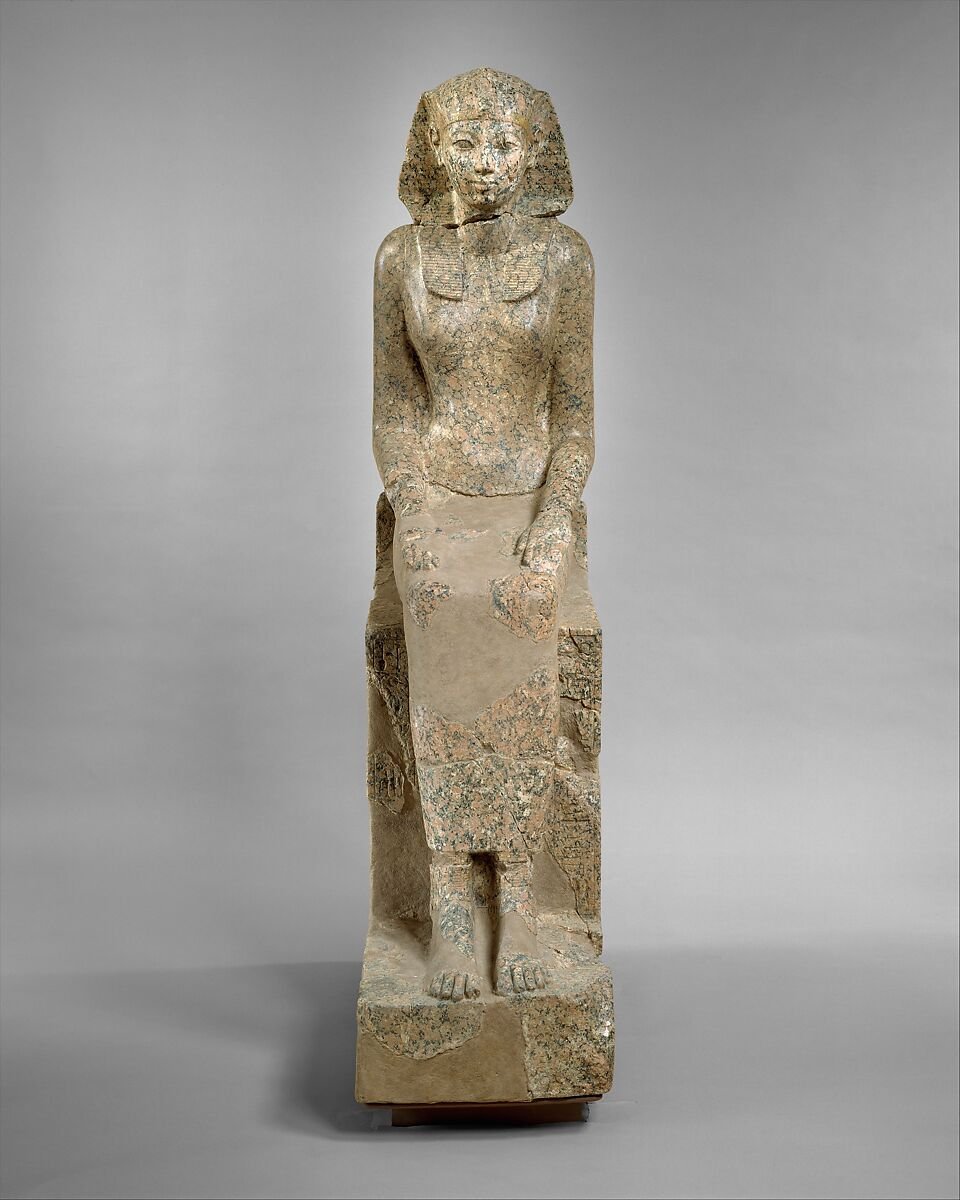
Hatshepsut, recovered and reassembled. Source: The Metropolitan Museum of Art.
The restricted books of 2 Esdras, Enoch’s uneven reception, delayed access to the Dead Sea Scrolls, and official debates over UFO reporting and disclosure make custody a serious question.222324 These are different histories, not evidence of one organization hiding aliens. They show how access and interpretation can shape what later generations are permitted—or equipped—to understand.
Who could examine the record before its explanation became accepted history? That is the critique worth pursuing. Conservation and security can justify restrictions, but they need not end independent scrutiny. A contact clue might be lost, misread, or knowingly concealed; each possibility needs its own documentary trail. Neither institutional authority nor suspicion should decide the answer in advance.
Who gets to decide which questions are respectable?
Why do so many readers distrust confident accounts of the past? Partly because a museum label rarely has room for the unfinished argument behind it. “Our strongest explanation” can become “nothing remains to ask.” A religious interpretation can acquire the same finality. So can an alternative-history documentary.
The Amazon supplies a concrete warning. The researcher who led the Upano investigation describes early resistance to evidence of a more complex forest society: prevailing expectations made the remains harder to recognize. Later surveys and excavation changed the picture.25 That is not an alien discovery. It is a documented reason to question whether an inherited model is helping us see—or telling us where not to look.
Professional defensiveness, reputational costs, funding priorities, and restricted access are legitimate subjects of scrutiny. Has a contrary measurement been answered or quietly bypassed? Are outsiders allowed to inspect enough evidence to challenge the conclusion? Does an unusual proposal receive a specific objection, or merely a warning that asking the question is unserious? Motives cannot be inferred from a job title, but decisions and response histories can be examined.
The strongest religious accounts deserve that same close attention. Calling Vasu’s vehicle “mythology” does not explain its privileged access. Calling the Watchers symbolic does not complete an analysis of their oath and differentiated teaching. Calling Ezekiel’s account a vision does not establish what produced it. A theological reading may explain those details very well; the point is to require the explanation rather than substitute the category for it.
Archaeologists and manuscript specialists have made many of the discoveries in this article. They are not one hostile bloc. But neither scholarly prestige nor reverence for an interpretation should exempt a claim from a hard question. An explanation earns authority by showing its work and stating what could overturn it.
The same rule applies to an alternative researcher withholding raw scans or selling certainty from selected photographs. A sympathetic audience should demand more, not less, from a claim it wants to be true.
Which ancient-contact scenario has actually been tested—and which has simply been placed outside the acceptable conversation? That is the critique I want to retain. Dismissal should have to identify its evidence as clearly as belief does.
Could the visitors be gone while their machines remain?
Why assume that contact requires a biological visitor standing before a witness? An autonomous instrument could outlast its makers. A probe might repeat a task for centuries. An inherited device might remain usable while its manufacture became impossible. A long-lived intelligence could be encountered by generations who never realized they were meeting the same presence.
These speculative scenarios matter because their traces would differ. A worldwide industrial empire should leave a broad technological footprint. A short expedition or a lone instrument need not. Evidence against the first cannot automatically eliminate the others.
Government UAP files make the modern sky a legitimate subject of inquiry. They also raise questions about what has been released, what remains inaccessible, and whether public analysts can reproduce an official conclusion. A released infrared recording is evidence that something was recorded; it is not yet evidence that the source is extraterrestrial. Conversely, an internal explanation is harder for outsiders to evaluate when its decisive data remain unavailable.26
The star-shaped image beside Ezekiel belongs in that discussion. Its resemblance invites a question about recurring forms. A real ancient-modern connection would require a distinctive feature independently established in both records, not a similarity selected after searching hundreds of pictures. What feature could we specify now that the next observation would confirm or contradict?
The Moon and Mars offer another search space. Durable artifacts might survive differently away from Earth’s erosion and rebuilding. Recent Martian organic findings strengthen questions about extraterrestrial chemistry and possible life; they do not establish a visiting civilization.27 A biological discovery would be profound without having to solve the entire contact question at once.
Plasma beings and other unfamiliar forms of agency belong among the alternatives, with predictions about persistence, energy, behavior, and response. An eerie shape is not consciousness. But rejecting a conventional spacecraft explanation should not silently close every nonhuman possibility either.
What would visitors actually leave behind—and are we searching for that, or only for the easiest version of the theory to reject?
From lunar lights to locked caves: which questions are still open?
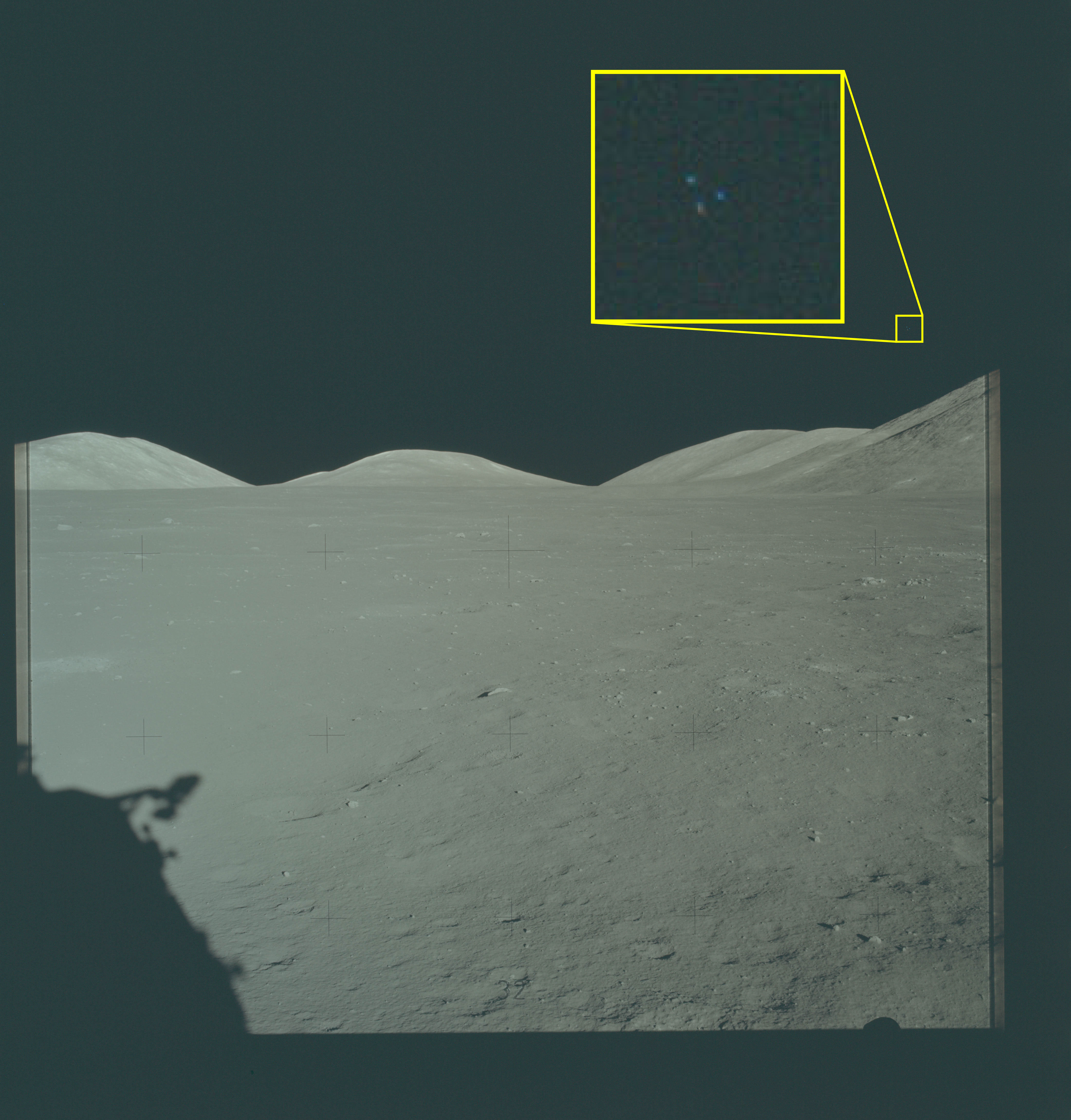
The official Apollo 17 release brings a lunar mystery back to an inspectable record: three points of light, with a preliminary suggestion of a physical object and further original-film analysis described in the catalogue.28 Nothing there identifies an alien. The consequential issue is whether independent examination can establish what was recorded.
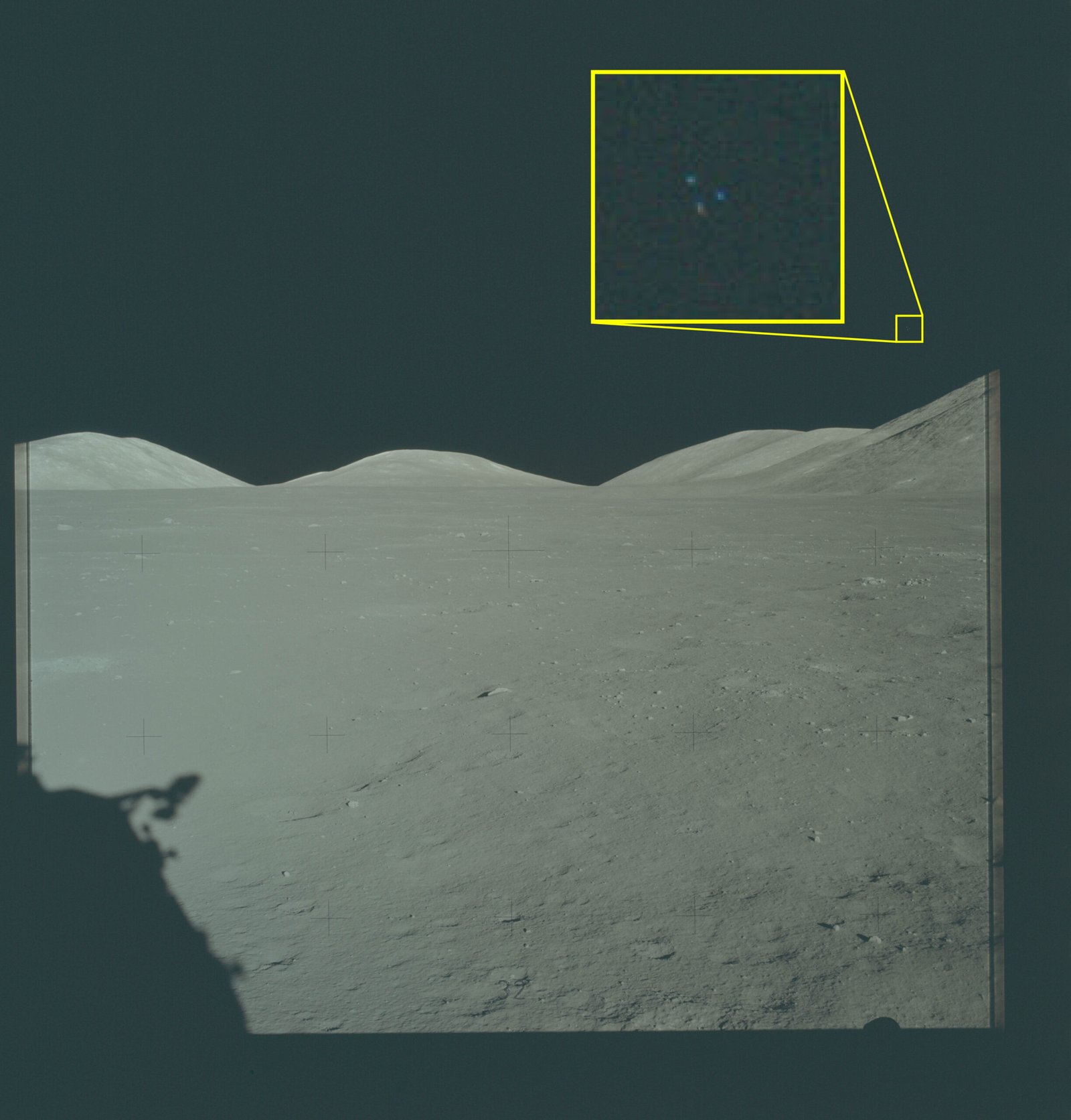
Apollo 17: three-dot image under investigation, 1972. Source: NASA / PURSUE, VM006.
Mars offers a warning and an invitation. Cydonia’s “face” inspired theories of an artificial monument; later imaging supports a natural landform.29 That weakens this particular exhibit, not every search for extraterrestrial traces. Investigations of possible Martian biosignatures also keep the origin-of-life question alive, without establishing intelligent visitors or deliberate seeding.30
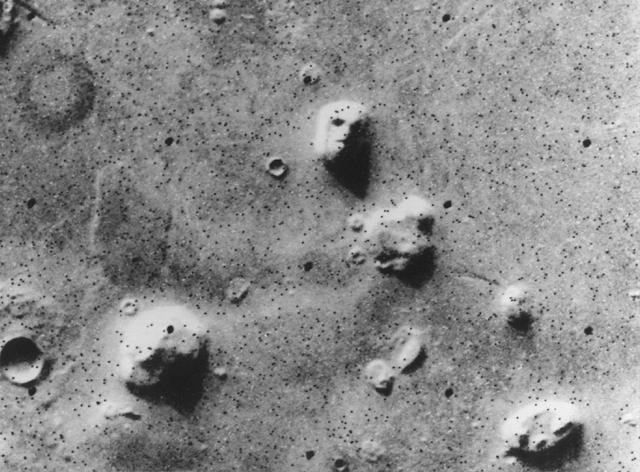
Cydonia’s “face,” Viking, 1976. Source: NASA / JPL, PIA01141.
Grand Canyon’s cliff openings make hidden-world stories visually compelling. Those pictured here are known ancestral granaries at Nankoweap, not proof of the alleged Egyptian cavern.31 The park is open; cave entry is restricted for conservation. The separate 1909 underground-discovery story remains unverified.3233 Legitimate protection should still allow accountable research and scrutiny of collections.
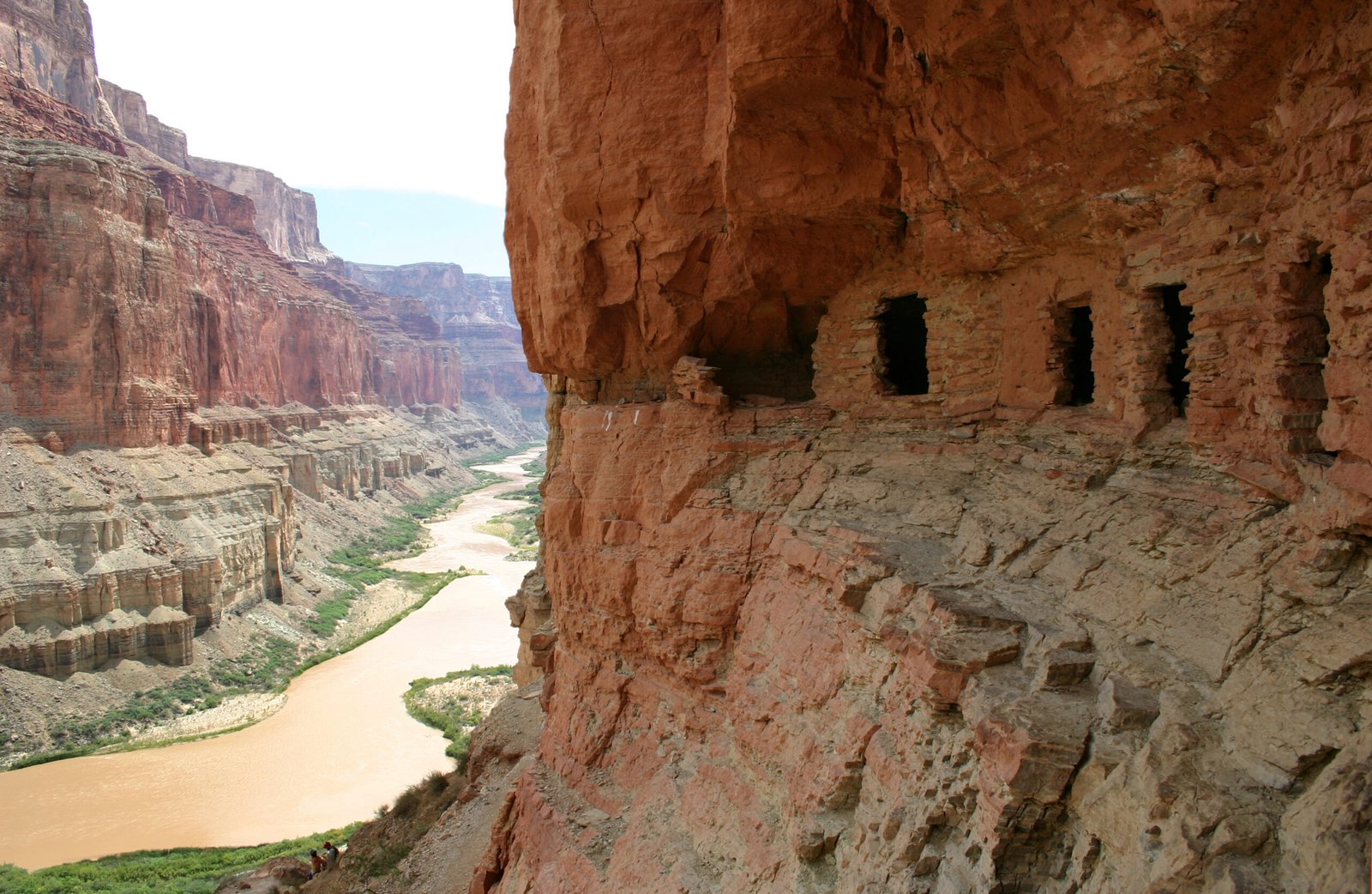
Nankoweap cliff granaries, Grand Canyon. Source: NPS / Mark Lellouch.
Skinwalker Ranch adds claims of aerial lights, electromagnetic disturbances, and portals, still needing independent replication.34 Across these controversies, the challenge is the same: release enough evidence to distinguish an extraordinary encounter from an extraordinary interpretation. Closed access deserves scrutiny; it does not identify what lies behind the door.
Why the ancient alien theory still divides us
The strongest objection to ancient contact is not that the idea sounds strange. It is that extraordinary descriptions have not yet been securely connected to extraterrestrial events. Ezekiel’s wheels, the Watchers’ forbidden teaching, and the Mahabharata’s aerial vehicles deserve close examination. But historians and theologians reasonably ask whether their details are better explained by sacred symbolism, literary development, or the worlds their writers knew. A technological reading must explain the surrounding story as well as the striking passage.353637
The apparent connections also need untangling. Genesis and Enoch are related traditions, not independent eyewitness reports. Flood stories might preserve shared catastrophes, circulating narratives, or different experiences of recurring disasters. Similarity becomes more persuasive when we can establish when accounts arose, how they travelled, and which unusual details developed independently.
Archaeologists face the same problem in stone. Monumental scale and difficult engineering justify investigation, but neither identifies an alien instructor. Egyptian construction evidence and local Andean craftsmanship are substantial counterweights to extraterrestrial explanations. Likewise, humanity’s evolutionary history presents a serious constraint on claims of alien creation, even while later intervention remains a separate hypothesis.3839
Concealment adds another unresolved step. A withheld record can establish restricted access; it cannot establish the record’s supposed alien contents. Yet dismissing every access dispute as irrelevant would also be premature.40
Ancient creation and divine agency have been debated for centuries and millennia; today’s technological ancient-astronaut interpretation is much newer. The real disagreement is whether we are recognizing an unfamiliar history—or projecting our technological imagination onto an older one. That deserves evidence, not ridicule from either side.
Where the search for our missing past goes next
The next chapter may lie beneath a drowned coastline, within unresolved pyramid architecture, in a carefully investigated cavern, or among manuscript fragments whose fuller meaning has not yet been recovered. These are opportunities to investigate missing history—not promises that aliens await discovery. Controversial researchers can help identify questions worth pursuing; independent examination must establish which leads survive.41
The search also reaches beyond Earth. Original lunar and UAP records, disputed Martian formations, and possible traces of past life deserve investigation on their own terms. Finding life elsewhere would transform our understanding of the universe. Connecting it to humanity’s origins or ancient encounters would require another, much more demanding discovery. Keeping those questions distinct makes the exploration stronger.4243
Future articles can follow a few promising connections more closely: an ancient description beside a dated artifact, a proposed lost capability beside evidence of its manufacture, or a concealment allegation beside recoverable records. Scientists, archaeologists, historians, theologians, and alternative researchers all have something to contribute—and something to reconsider. The purpose is to discover where the contact interpretation gains support, where human ingenuity explains more, and where uncertainty genuinely remains.
The Popol Vuh’s clouded mirror and the Bhagavad Gita’s lost teaching leave an intriguing thought behind: something can survive while our understanding of it disappears.44 Perhaps further investigation will reveal forgotten visitors. Perhaps it will reveal forgotten humans. Either discovery would make our past stranger—and richer—than the story we thought was complete.
Books behind this exploration
These eight books form the core reading base. The full research report retains the chronology, evidence comparisons, other traditions, and detailed source review.
- Chariots of the Gods? — Erich von Däniken.
- Fingerprints of the Gods — Graham Hancock.
- The Book That Will Forever Change Our Ideas About the Bible, subtitled The Gods Coming from Space — Mauro Biglino, referenced 2013 edition; a different title from Gods of the Bible.
- Four Vedas — Rig and Sama material, the Yajur Veda’s Taittiriya Samhita, and selected Atharva hymns; not all recensions or the complete Atharvaveda.
- The Complete Mahabharata, Volumes 1–12, including the Bhagavad Gita — a literary retelling considered alongside the wider epic tradition.
- Bible with Apocrypha.
- The Complete Book of Enoch — a compilation whose ancient components and later supplements are distinguished in the report.
- The Twenty-Four Books of the Holy Scriptures — the Tanakh, including the Torah.
Additional texts and traditions include Mesopotamian compositions, Egyptian writings, the Ramayana, Avesta, Qur’an, Buddhist sources, and the Popol Vuh. Their inclusion is a comparison, not a claim that they all describe the same visitors. Image credits and reuse details.
Sources and further reading
Bible, Genesis 1:26–27; The Twenty-Four Books of the Holy Scriptures, corresponding passage; Four Vedas, Rig 10.129.6–7. Chariots of the Gods?, chapter 4, and The Book That Will Forever Change Our Ideas About the Bible, pp. 42–45, explicitly develop the creation question. Singular creation language follows plural deliberation; both belong to the comparison.↩︎
Oxford ETCSL, Enki and Ninmah; Atra-hasis, creation and flood episodes. The report distinguishes these compositions from modern Anunnaki–Nibiru syntheses.↩︎
Bible, Genesis 6:1–4; The Complete Book of Enoch, Book 1, chapters 3–4 in the referenced compilation, broadly standard 1 Enoch 6–11. The compilation’s numbering differs from standard Enoch references.↩︎
The three modern books listed below, with Fingerprints of the Gods, chapters 21 and 52; official book page. The synthesis in this article is my interpretation, not a position attributed jointly to the authors.↩︎
The Complete Mahabharata, canto 63; Mahabharata, Adi Parva LXIII; for restraint on the Pashupata, Vana Parva XL. Full Sanskrit Critical Edition collation remains further work, not a completed result.↩︎
The Complete Mahabharata, canto 63; Mahabharata, Adi Parva LXIII; for restraint on the Pashupata, Vana Parva XL. Full Sanskrit Critical Edition collation remains further work, not a completed result.↩︎
Four Vedas: Rig 4.35–36; Yajur, Taittiriya Samhita III.2.1; Sama collection’s opening Agni hymns; Atharva IV.12. The report preserves the ritual and healing contexts rather than treating the collections as one technical account.↩︎
Bible, Ezekiel 1:4–28 and chapter 10; corresponding material in The Twenty-Four Books of the Holy Scriptures; Chariots of the Gods?, chapter 4. The illustration is later religious art, not an eyewitness picture.↩︎
AARO / DVIDS, DOW-UAP-PR38, Middle East, 2013, published 8 May 2026. The official descriptive caption expressly declines to make an analytical identification. The image’s exact frame and processing history are not established by its filename; see the image-credit register.↩︎
“Anatomy of a Palimpsest: The Not-So-Strange Case of the ‘Abydos Helicopter’,” Kmt 27/1 (2016), pp. 61–66. It reconstructs the inscriptions using parallels within the temple and also critiques errors in popular skeptical diagrams.↩︎
ScanPyramids Big Void, 2017; north-face corridor, 2023; multimethod corridor study, 2025; ultrasonic investigation, 2026. The report separates building evidence, unknown geometry, and proposed functions.↩︎
Egypt’s Ministry of Tourism and Antiquities, Serapeum. The bull-burial context is documented; the technical and repurposing questions are hypotheses posed here, not findings announced by the ministry.↩︎
Retraction notice, 10 August 2026. An imaging-method reliability problem and the physical existence of a proposed feature require different assessments.↩︎
Tiwanaku architectural reconstruction study; UNESCO, Nasca and Palpa; 2024 Nazca field-survey announcement; PNAS study. New figures are not new proof of their audience’s identity.↩︎
Yale’s 2021 radiocarbon-study announcement and UNESCO, Historic Sanctuary of Machu Picchu. Occupation dates do not independently date every stone or identify a source of instruction.↩︎
UNESCO, Moenjodaro; report sections 6.3 and 13 for undeciphered writing, urbanism, and the source problems of nuclear-destruction claims.↩︎
Göbekli Tepe; Kalambo Falls wood, 2023; White Sands independent dating, 2023; CNRS on the Upano investigations. See the report for dates and the distinction between human presence, construction, settlement, and industrial capability.↩︎
Bible and The Twenty-Four Books of the Holy Scriptures, Genesis 6–9; The Complete Mahabharata, canto 186; Mahabharata, Vana Parva CLXXXVI; Atra-hasis and Gilgamesh XI; Avesta, Vendidad 2. The divine fish’s identification varies across traditions; the referenced epic account does not authorize treating every version as identical.↩︎
Noah’s Ark Scans’ own announcements: core drilling, 23 September 2026; preliminary radar interpretation, 1 October 2026. These are project-issued releases, not independent peer-reviewed confirmations. The report assesses the larger claims and tests separately.↩︎
Collins and Fasold, Journal of Geoscience Education 44 (1996), pp. 439–444, author-hosted text. Its analysis concerns earlier samples and observations; new materials require their own tests.↩︎
Bible with Apocrypha, 2 Esdras 14:37–48; Tertullian, I.3; Augustine, XV.23; Library of Congress on Scrolls access; Hatshepsut statue object history; 2025 reassessment of statue damage. These are different kinds of record change, not evidence of one shared motive.↩︎
Bible with Apocrypha, 2 Esdras 14:37–48; Tertullian, I.3; Augustine, XV.23; Library of Congress on Scrolls access; Hatshepsut statue object history; 2025 reassessment of statue damage. These are different kinds of record change, not evidence of one shared motive.↩︎
Robertson Panel / Durant report, Appendix U, especially “Educational Program” and “Unofficial Investigating Groups.” A proposed public-response program is documented; a concealed extraterrestrial discovery is not established by that document.↩︎
NASA-commissioned Brookings report, Proposed Studies on the Implications of Peaceful Space Activities for Human Affairs, pp. 182–184; Brookings page-image excerpt. Page 184 proposes studying the circumstances and purposes of presenting or withholding discovery information. It does not document an existing extraterrestrial discovery or an implemented concealment policy.↩︎
Göbekli Tepe; Kalambo Falls wood, 2023; White Sands independent dating, 2023; CNRS on the Upano investigations. See the report for dates and the distinction between human presence, construction, settlement, and industrial capability.↩︎
Official UAP imagery catalogue; NASA UAP study. The full research report keeps case-specific explanations, testimony, disclosure allegations, and remaining data gaps separate.↩︎
NASA, 6 February 2026 organic-abundance study and 21 April 2026 organic-molecule announcement. Report sections 3 and 12 distinguish life, intelligence, visitation, persistent machines, and plasma speculation.↩︎
PURSUE official release catalogue and its source metadata, checked 1 October 2026: NASA-UAP-VM002 and VM006, released 8 May 2026. Annotations are part of the government-hosted files. The VM006 entry describes preliminary analysis and forthcoming fuller results, not an extraterrestrial identification. Publication in a new collection does not establish that the original photograph was previously secret.↩︎
NASA, Viking image PIA01141, 2001 high-resolution image PIA03225, and later landform interpretation. Both earlier and later observations belong in the comparison.↩︎
NASA, potential biosignature in the Cheyava Falls sample, 10 September 2025. A possible biological origin requires further testing; no link to terrestrial seeding or ancient contact is established.↩︎
NPS / Mark Lellouch, Nankoweap granaries photograph, 24 August 2004; NPS, Nankoweap granary site. These documented ancestral structures are separate from the unverified cavern allegation.↩︎
NPS, Cave / Karst Systems, policy page updated 11 May 2024. Its conservation rationale is not a claim that every cave contains artifacts. The park is not generally closed to visitors.↩︎
Smithsonian institution’s response to the Grand Canyon allegation, item 4. The 5 April 1909 Arizona Gazette story is an allegation, not an authenticated excavation report; the response is the institution’s stated position, not a substitute for examining any independently recoverable evidence.↩︎
Ranch-operated investigation and access description; HISTORY’s producer account of the portal and buried-object claims. Both are interested-party accounts. The claims are included for investigation, not as independently replicated findings.↩︎
Bible, Ezekiel 1:4–28 and chapter 10; corresponding material in The Twenty-Four Books of the Holy Scriptures; Chariots of the Gods?, chapter 4. The illustration is later religious art, not an eyewitness picture.↩︎
Bible, Genesis 6:1–4; The Complete Book of Enoch, Book 1, chapters 3–4 in the referenced compilation, broadly standard 1 Enoch 6–11. The compilation’s numbering differs from standard Enoch references.↩︎
The Complete Mahabharata, canto 63; Mahabharata, Adi Parva LXIII; for restraint on the Pashupata, Vana Parva XL. Full Sanskrit Critical Edition collation remains further work, not a completed result.↩︎
ScanPyramids Big Void, 2017; north-face corridor, 2023; multimethod corridor study, 2025; ultrasonic investigation, 2026. The report separates building evidence, unknown geometry, and proposed functions.↩︎
Tiwanaku architectural reconstruction study; UNESCO, Nasca and Palpa; 2024 Nazca field-survey announcement; PNAS study. New figures are not new proof of their audience’s identity.↩︎
Bible with Apocrypha, 2 Esdras 14:37–48; Tertullian, I.3; Augustine, XV.23; Library of Congress on Scrolls access; Hatshepsut statue object history; 2025 reassessment of statue damage. These are different kinds of record change, not evidence of one shared motive.↩︎
Göbekli Tepe; Kalambo Falls wood, 2023; White Sands independent dating, 2023; CNRS on the Upano investigations. See the report for dates and the distinction between human presence, construction, settlement, and industrial capability.↩︎
PURSUE official release catalogue and its source metadata, checked 1 October 2026: NASA-UAP-VM002 and VM006, released 8 May 2026. Annotations are part of the government-hosted files. The VM006 entry describes preliminary analysis and forthcoming fuller results, not an extraterrestrial identification. Publication in a new collection does not establish that the original photograph was previously secret.↩︎
NASA, potential biosignature in the Cheyava Falls sample, 10 September 2025. A possible biological origin requires further testing; no link to terrestrial seeding or ancient contact is established.↩︎
Popol Vuh, pp. 185–186, also discussed in Fingerprints of the Gods, chapter 21; The Complete Mahabharata, “Srimad Bhagavad Gita Continued,” “Gyana yoga: The way of knowledge,” corresponding to Bhagavad Gita 4.1–5. The lost teaching is yoga; unequal remembrance concerns previous births, not a stated erasure operation.↩︎
Image credits and reuse details
- atrahasis-tablet.jpg — The Met, 86.11.378a, Purchase, 1886; Object ca. seventh–sixth century BCE; Public domain, as designated by the Met.
- pushpak-vimana-temple.jpg — Photograph of a carved architectural and figural temple scene; Exact monument, date, scene identification, and camera source unverified; filename is not proof it depicts Pushpaka; No verified reuse permission.
- vimana-concept.jpg — Mixed collage juxtaposing balloon, temple elevation, and flying-palace imagery; Individual artists, dates, source editions, and compilation creator unknown; not one ancient plan; No verified reuse permission for the composite or its components.
- garuda-web.jpg — Garudas at Wat Phra Kaew, Bangkok; xiquinhosilva; Photograph 1 October 2016; CC BY 2.0; proportional resizing only.
- krishna-and-arjuna.jpg — Religious painting of Krishna’s cosmic revelation to Arjuna; Creator, date, edition, and reproduction source unknown; illustrative rather than archaeological evidence; No verified reuse permission.
- Ezekiel-Vision-Merkaba.jpg — Historical-looking religious engraving depicting Ezekiel, a multiheaded being, and wheel; Print identity, creator, date, and reproduction source not verified; not an eyewitness drawing; No verified permission for this reproduction.
- Ezekiel-Vision-ufofiles.png — Infrared image with star-shaped contrast, tracking marks, and blacked-out areas; scene resembles the related AARO / DVIDS PR38 recording; Exact frame, crop, processing history, and original download source not matched; apparent sensor pattern is not a certified physical shape; Related official video is designated public domain; that does not authenticate or automatically license every third-party derivative.
- dogu.jpg — Dogu (Musée national de Tokyo, Japon) (43338322292).jpg; Jean-Pierre Dalbéra from Paris, France; Photo 20 May 2018; object approximately 1000–400 BCE; CC BY 2.0.
- dendera.jpg — Z92 1563-69dev Temple of Hathor – ‘Dendera light’ pano1bLfE(Xsz)T(Wiki)F.jpg; DanielFFF; Photo 6 October 2023; ancient temple relief; source annotations retained; CC BY-SA 4.0.
- abydos.jpg — Hieroglif z Abydos.jpg; Olek95; Photo July 2009; New Kingdom carvings; Public domain.
- pyramidsphinx.jpg — Photograph showing the Sphinx and pyramids at Giza; Original photographer and publication source unknown; No verified reuse permission.
- Serapeum-of-Saqqara-Egypt-Tours-Portal.jpeg — Photograph of a monumental stone sarcophagus in the Serapeum; visible Egypt Tours Portal watermark; Watermark identifies a credited distributor but does not establish ownership or permission; no dimensional tolerance can be inferred from the photograph alone; No verified reuse permission; watermark retained.
- pumapunku.jpg — Benjamin Burga, Wikimedia Commons; Photograph 15 July 2017; CC BY-SA 4.0.
- nazca-owlman.jpg — Líneas de Nazca, Nazca, Perú, 2015-07-29, DD 46.JPG; Diego Delso; Photo 29 July 2015; ancient geoglyph; CC BY-SA 4.0.
- machu-picchu-sun-temple.jpg — Unukorno, Sun Temple Machu Picchu; Photograph September 26, 2013; architecture, not evidence of an alien builder; CC BY 3.0; creator and licence linked under image.
- mohenjo-daro-excavation.jpg — The Great Bath at Mohenjo-daro. Wellcome L0005461.jpg; Wellcome Collection, L0005461; 1920s excavation image, published in John Marshall’s 1931 book; CC BY 4.0.
- noahsark.png — Composite of landscape views and colored scan visualization; visible credit names Noah’s Ark Scans; Composite’s original date/source and processing unverified; candidate formation is not an authenticated vessel; scan output is interpretation; No verified reuse permission.
- hatshepsut.jpg — The Met, 29.3.3, Rogers Fund, 1929; torso lent by Rijksmuseum van Oudheden, Leiden; Object ca. 1473–1458 BCE; Public domain, as designated by the Met.
- moon-apollo17-vm006.jpg — NASA / PURSUE, VM006; Apollo 17, December 1972; released May 8, 2026; original-film investigation described in release entry; NASA mission photograph in official government release; source annotations retained; no endorsement implied.
- mars-cydonia-viking-1976.jpg — NASA / JPL, PIA01141; Viking, July 25, 1976; low-resolution face-like appearance; NASA mission imagery; credit NASA/JPL; published image unchanged.
- grand-canyon-nankoweap-granaries.jpg — NPS / Mark Lellouch, photograph 3516; Commons provenance; 24 August 2004; rectangular openings in documented ancestral granaries, not an Egyptian cavern or alien structure; NPS employee work identified as U.S. public domain; Commons also records CC BY 2.0. Credit NPS / Mark Lellouch retained; no new image alteration or endorsement implied.
.jpg)
_(43338322292).jpg)
T(Wiki)F.jpg)